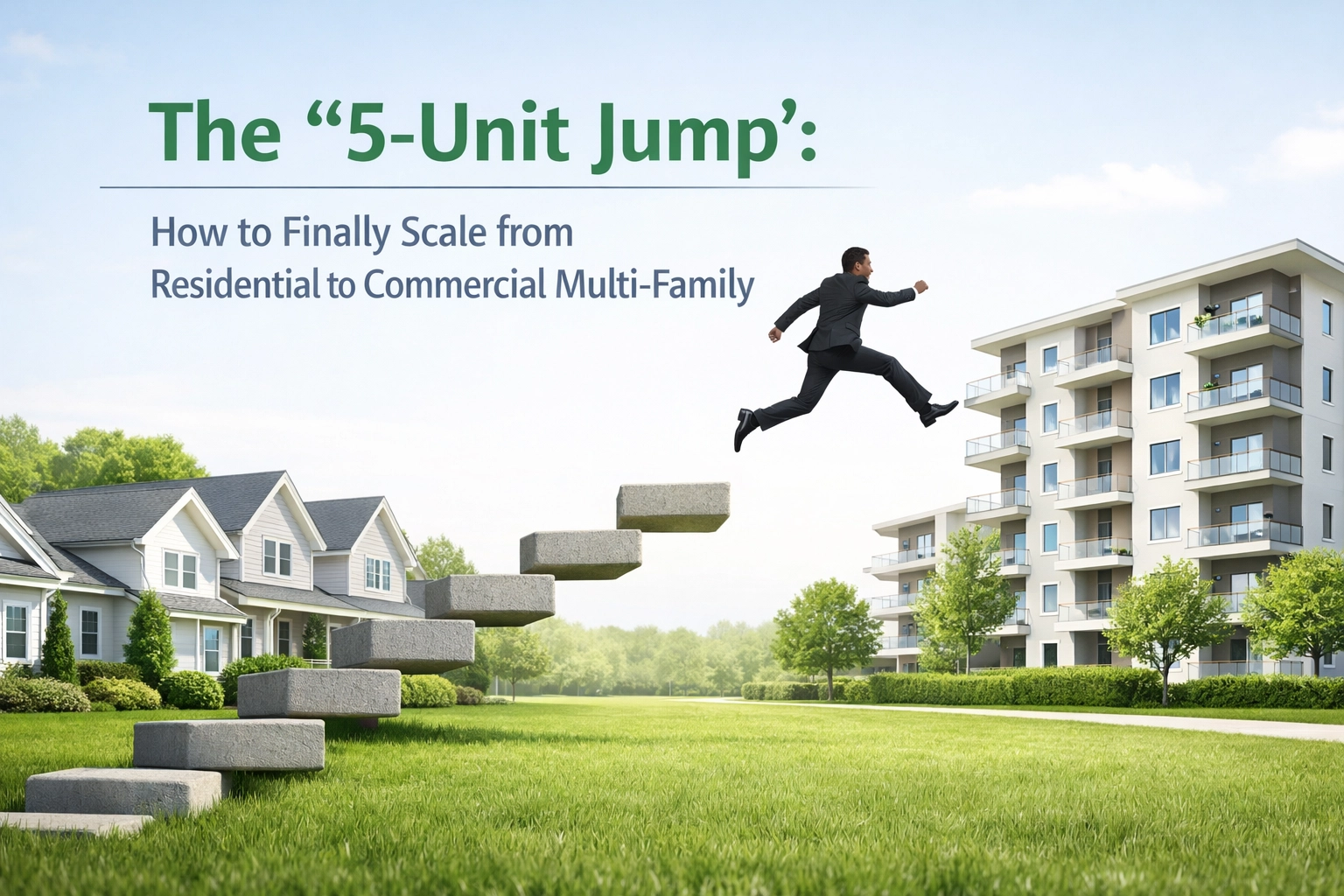

If you’re considering making the leap from single-family rentals or small duplexes into the world of "real" multi-family, welcome to the big leagues. Most investors start their journey in the 1-4 unit space. It’s familiar, the financing is straightforward, and it feels manageable. But eventually, every ambitious investor hits a wall. You realize that managing ten different single-family houses across town is a logistical nightmare, and scaling one door at a time is a slow crawl toward financial freedom.
The solution? The "5-Unit Jump."
In the eyes of the lending world, the moment you move from 4 units to 5 units, everything changes. You stop being a "residential borrower" and start being a "commercial investor." This transition is where real wealth is built, but it’s also where many investors get tripped up by old habits. At Emerald Capital Funding, we’ve helped countless investors cross this bridge, and this guide will equip you with the knowledge to do it without the traditional bank headaches.
Why 5 Units is the Magic Number for Scaling
Before we dive into the mechanics, let’s talk about why the number five is so significant. In real estate, properties with 1 to 4 units are classified as residential. They are valued based on "comparables", what the house down the street sold for.
Once you hit 5 units or more, you’ve entered the commercial multi-family space. These properties aren't valued based on your neighbor’s curb appeal; they are valued based on the income they produce. This is a game-changer for your net worth.
The Power of Forced Appreciation
With a single-family home, you can renovate the kitchen and hope the appraiser gives you a bump. With a 10-unit apartment building, if you increase the monthly rent by just $50 per unit through better management or minor upgrades, you’ve increased the annual Net Operating Income (NOI) by $6,000. At a 6% cap rate, you just added $100,000 in value to the property.
That is the "math of the jump," and it’s why scaling to 5+ units is the fastest pathway to financial security.

The Shift: Residential vs. Commercial Lending
One of the biggest hurdles in making the 5-unit jump is the shift in how you get paid, and how you get funded. If you’ve been using conventional mortgages, you’re used to debt-to-income (DTI) ratios, W-2 requirements, and deep dives into your personal tax returns.
When you move into 5+ unit territory with Emerald Capital Funding, the script flips. We care much more about the property’s performance than your personal paycheck.
1. Valuation Methodology
In the residential world, the appraiser looks at the three houses that sold nearby. In the commercial world (5+ units), we look at the Cap Rate (Capitalization Rate). This is the ratio of NOI to the property’s purchase price. Understanding this shift allows you to buy "ugly" properties with poor management, fix the operations, and create massive equity that simply doesn't exist in the residential space.
2. Underwriting Focus
Traditional banks often choke on commercial deals because they try to apply residential rules to them. At Emerald, we utilize DSCR-style underwriting even for larger multi-family assets. We look at the Debt Service Coverage Ratio, basically, does the property’s income cover the mortgage and expenses? If the math works, the deal works.
Actionable Takeaway: Stop worrying about your DTI and start focusing on the T-12 (Trailing 12-month) profit and loss statement of the property you’re eyeing. The property’s ability to generate cash is your greatest asset in securing a loan.
Navigating the Commercial "Paperwork" (It’s Simpler Than You Think)
Don't let the term "commercial" intimidate you. While the documents have different names, the process with a flexible lender is often smoother than a standard residential closing. To successfully scale to 5+ units, you need to get familiar with two main documents:
- The T-12 (Trailing 12 Months): This is the actual financial history of the property over the last year. It shows exactly what was collected in rent and exactly what was spent on repairs, taxes, and utilities.
- The Rent Roll: A snapshot of who is living in the units, how much they pay, and when their leases expire.
When you bring a 5+ unit deal to Emerald Capital Funding, we aren't going to ask for your 2023 tax returns and three months of pay stubs to see if you can afford the mortgage out of your own pocket. We’re going to look at the T-12 and the Rent Roll to see if the building can afford the mortgage.

Scaling Strategies: How to Fund the Jump
If you’re sitting on a few 1-4 unit properties, you likely have the "seed money" for your first commercial multi-family deal already. Here’s how pro investors make the jump:
The Equity Harvest
Many investors have significant equity trapped in their residential rentals. By performing a cash-out refinance on your 1-4 unit portfolio, you can pull out the capital needed for a down payment on a 10-unit or 20-unit building.
The Bridge-to-BRRRR Strategy
Found a 6-unit building that’s half-empty and needs work? A traditional bank won't touch it. However, you can use one of our bridge loans to acquire the property and fund the renovations. Once the units are renovated and occupied at market rents, you "refi" into a long-term commercial DSCR loan. This is how you scale an entire portfolio in a fraction of the time it takes to flip houses.
Actionable Takeaway: Audit your current portfolio. If you have equity sitting idle, you're losing money to inflation. Consider a refinance to fuel your 5-unit jump.
Common Pitfalls to Avoid When Scaling
Making the jump is exciting, but don't let the excitement blind you to the nuances of commercial real estate.
- Underestimating Expenses: In residential, you might guestimate 10% for repairs. In 5+ units, you need to account for property management, common area utilities, and "CAPEX" (Capital Expenditures like roofs and parking lots).
- Poor Management: You can self-manage a duplex. Self-managing a 12-unit building while holding a day job is a recipe for disaster. Budget for professional management from day one.
- Using the Wrong Lender: If you take a 10-unit deal to a small local bank, they might hit you with a 20-year amortization, a balloon payment in 5 years, and a mountain of personal guarantees. Emerald Capital Funding offers much more flexible terms that mirror the "investor-friendly" vibe of residential DSCR loans.

Frequently Asked Questions (Q&A)
Q: Do I need commercial experience to get a loan for a 5-unit building?
A: While experience helps, it’s not always a deal-breaker. If the property has a strong DSCR and you have a professional property management company lined up, we can often make the deal happen.
Q: Are interest rates much higher for 5+ units?
A: Not necessarily. While commercial rates fluctuate differently than the 30-year fixed residential rate, the benefits of forced appreciation and tax write-offs often far outweigh a slight difference in interest.
Q: Can I use my personal income to qualify if the building’s income is low?
A: In some cases, yes, but the goal is always to have the asset stand on its own. If the building isn't performing yet, we usually look at a bridge loan to get it stabilized.
Q: How much down payment do I need for a 5-unit property?
A: Typically, you’re looking at 20% to 25% down. However, if you are doing a value-add project, we can often fund a high percentage of the total cost (LTC).
Your Pathway to the Next Level
Scaling from residential to commercial is the single most important transition you will make as an investor. It shifts your focus from "working for your properties" to "having your properties work for you." The 5-unit jump isn't just about adding one more door; it's about changing the fundamental math of your wealth.
At Emerald Capital Funding, we specialize in the "in-between." We understand the needs of the investor who is too big for a local bank but wants more personal service than a massive institutional lender. We make the 5-unit jump easy with flexible terms, fast closings, and a focus on the asset's potential.
Ready to see what your first (or next) multi-family deal looks like?
Apply Now to get a quote, or contact our team today to discuss your scaling strategy. Success is within your reach; you just need the right leverage to grab it.