

If you're scaling your real estate portfolio from single-family rentals or small multifamily properties into larger apartment buildings, you're about to cross an important threshold. That magical fifth unit? It doesn't just mean more rental income, it fundamentally changes how lenders look at your deal.
Welcome to the world of commercial multifamily DSCR loans. The good news? You still don't need to show tax returns or W-2s. The structure just gets a bit more sophisticated. Let's break down exactly what changes when you make the leap from 1-4 units to 5+ units, and why understanding these differences can save you thousands (and speed up your next acquisition).
The Great Divide: Why 5 Units Changes Everything
Here's the deal: in the lending world, there's a clear line drawn at five units. Properties with 1-4 units fall under "residential" financing guidelines, backed by entities like Fannie Mae and Freddie Mac. But the moment you hit that fifth unit, you've entered commercial territory.
This isn't just semantics, it affects everything from your loan structure to your down payment requirements. Traditional conventional loans simply aren't available once you cross into 5+ unit properties. That's where specialized DSCR programs for multifamily properties come into play.

The shift makes sense when you think about it. A 20-unit apartment building operates more like a business than a house with a basement apartment. Lenders want to see that the property itself can sustain the debt, not just that you personally have a good income.
How DSCR Requirements Shift for Larger Properties
With single-family or small multifamily DSCR loans, you might see minimum DSCR ratios as low as 1.0 (meaning the property's rental income exactly covers the mortgage payment). Some aggressive programs even dip below that.
Once you're looking at 5+ units, expect those minimums to tighten up. Most commercial multifamily DSCR programs require a minimum DSCR of 1.15 or higher. Translation? The property needs to generate 15% more income than the debt payment, a built-in cushion for vacancies, maintenance, and market fluctuations.
That said, some specialized programs for 5-8 unit properties still allow a 1.0 DSCR, especially if other aspects of the deal are strong (solid location, experienced borrower, good cash reserves). But you should plan for more conservative underwriting as you scale up.
Quick Math Refresher:
If your annual debt service (mortgage payment × 12) is $60,000, and your net operating income is $69,000, your DSCR is 1.15. That meets most multifamily thresholds. But if your NOI is only $60,000? That's a 1.0 DSCR, which might work for a duplex but could be a deal-killer on an eight-plex.
The Big Changes You Need to Know About
All Units Must Be Leased and Producing Income
Here's where things get strict. Unlike 1-4 unit DSCR loans (which can finance vacant properties), 5+ unit multifamily DSCR programs require all rental units to be leased and actively generating income at the time of closing.
This means you can't buy a distressed 12-unit apartment building with half the units empty and expect to secure DSCR financing right away. You'd need to either negotiate seller financing, use a bridge loan to stabilize the property first, or bring significant cash reserves to the table.

Owner Occupancy Is Off the Table
Planning to live in one unit while renting out the others? That won't fly with commercial multifamily DSCR loans. These programs are strictly for non-owner-occupied investment properties. If any portion is owner-occupied, you'll need to explore different financing routes.
Appraisals Focus on Income, Not Comps
Forget about comparable sales being the primary valuation method. For 5+ unit properties, appraisers use income-based approaches. They're looking at your property's ability to generate revenue, cap rates, operating expenses, net operating income, and market rent potential.
This actually works in your favor if you're buying a well-managed property with strong financials. The income approach rewards properties that perform, not just properties in trendy neighborhoods.
Experience Requirements Get Real
Here's one area where you can't fake it. While many DSCR programs for 1-4 units accept first-time investors with open arms, 5+ unit multifamily financing typically requires proven experience.
Most lenders want to see one of the following:
- Previous ownership of at least one 5+ unit property, OR
- Track record with three or more smaller 1-4 unit investment properties
If you're new to real estate investing and dreaming of going straight to a 16-unit apartment complex, pump the brakes. Build your experience with smaller deals first, or consider bringing on an experienced partner.
Down Payments and LTV Ratios
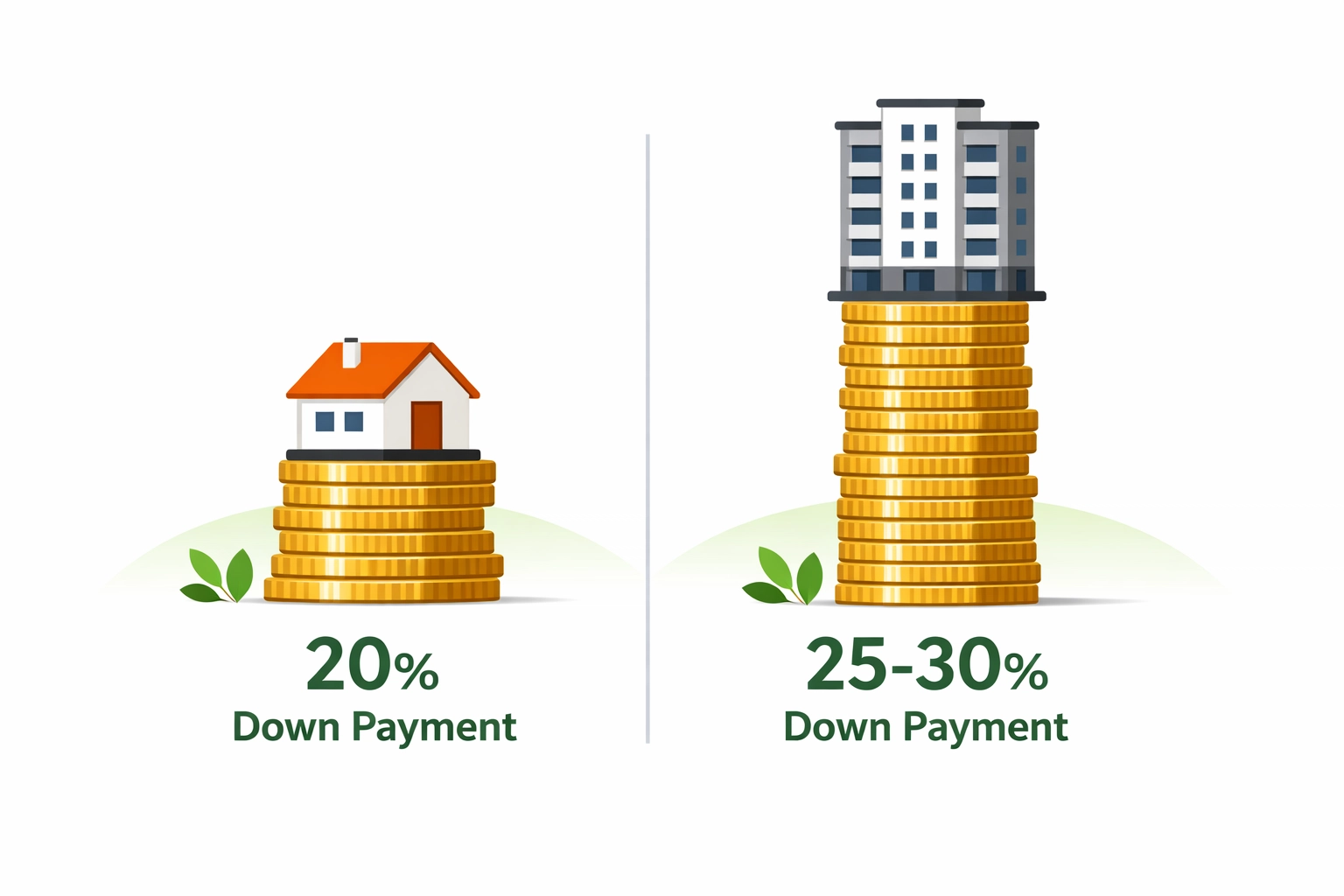
You're going to need more skin in the game. While some 1-4 unit DSCR programs offer financing up to 80% LTV (20% down), multifamily properties typically require at least 25% down on purchases.
Here's the breakdown:
- Purchases: Expect 25-30% down payment requirements
- Rate-and-term refinances: Max out around 75% LTV
- Cash-out refinances: Capped at 65% LTV for 5-8 unit properties
The flip side? Maximum loan amounts increase significantly, often reaching $2-2.5 million depending on the lender and property performance. You're playing at a bigger scale now.

Still No Tax Returns or W-2s Required
Despite all these changes, here's what stays the same: you still don't need to provide personal income documentation. No tax returns. No W-2s. No employment verification.
DSCR loans, even at the commercial multifamily level, qualify you based solely on the property's ability to cover its own debt. This is massive for investors who have excellent real estate income but complicated personal tax situations, or for those who simply want to scale faster without personal income becoming the bottleneck.
Why This All Matters for Your Portfolio Strategy
Understanding these distinctions helps you plan your growth trajectory intelligently. If you're currently managing three duplexes and eyeing a 10-unit building, you now know that the underwriting process will be fundamentally different.
You'll need to:
- Ensure all units have paying tenants before closing
- Accept higher down payment requirements
- Demonstrate your multifamily experience (or partner with someone who has it)
- Target properties with strong income performance to hit those DSCR minimums
But here's why it's worth it: commercial multifamily properties offer scale that's hard to achieve otherwise. Managing one 12-unit building is often easier than managing 12 separate single-family homes scattered across town. Your cost per door drops. Your operational efficiency increases. Your wealth-building accelerates.
Q&A: Your Multifamily DSCR Questions Answered
Q: Can I use projected rents instead of actual leases for a 5+ unit DSCR loan?
A: Generally, no. Most multifamily DSCR programs require actual signed leases and current rent rolls. Projected rents might factor into the appraisal's market analysis, but you'll need real tenants paying real rent to qualify.
Q: What if I own two 4-plexes but never a 5+ unit property: does that count as experience?
A: Absolutely. Two 4-plexes give you eight total units of experience, which most lenders will view favorably. Three smaller 1-4 unit properties typically satisfy the experience requirement for moving up to 5-8 unit financing.
Q: Are interest rates higher for 5+ unit DSCR loans compared to smaller properties?
A: They can be, but not dramatically. You're typically looking at an additional 0.25-0.75% on your rate compared to equivalent 1-4 unit DSCR programs. The increased rate reflects the higher risk and commercial classification, but the difference isn't usually a deal-breaker.
Q: How long do these loans take to close?
A: Most multifamily DSCR loans close in 30-45 days, similar to residential DSCR programs. The timeline can extend if property appraisals are complex or if you're dealing with environmental reviews on larger properties.
Making the Leap with the Right Partner
Scaling from residential to commercial multifamily is a significant milestone in your investing journey. The lending landscape shifts, the requirements tighten, and the stakes get higher: but so does the potential for substantial passive income and long-term wealth.
At Emerald Capital Funding, we specialize in helping investors navigate this exact transition. We understand that your duplex portfolio prepared you for this moment, and we structure multifamily DSCR loans that recognize your experience while keeping the process straightforward.
No tax return hassles. No employment verification. Just strong property fundamentals and a lender who knows how to move quickly on the right deals.
Ready to explore how a multifamily DSCR loan can accelerate your next acquisition? Let's talk about your specific property and create a financing structure that works. Reach out to our team today and let's get you moving on that 5+ unit opportunity sitting in your pipeline.
The commercial multifamily world isn't as intimidating as it seems: especially when you've got a lender who speaks your language and moves at investor speed.