

If you're diving into the fix and flip game, you've probably wondered which financing option will actually help you win deals and maximize profits. Here's the straight answer: hard money loans are typically the superior choice for fix and flip projects because they're designed specifically for the fast-paced, deal-focused world of real estate investing.
But that doesn't mean conventional rehab loans don't have their place. Let's break down exactly when each option makes sense, so you can make the smartest choice for your next project.
Why Hard Money Often Wins for Fix and Flips
Speed That Actually Matters
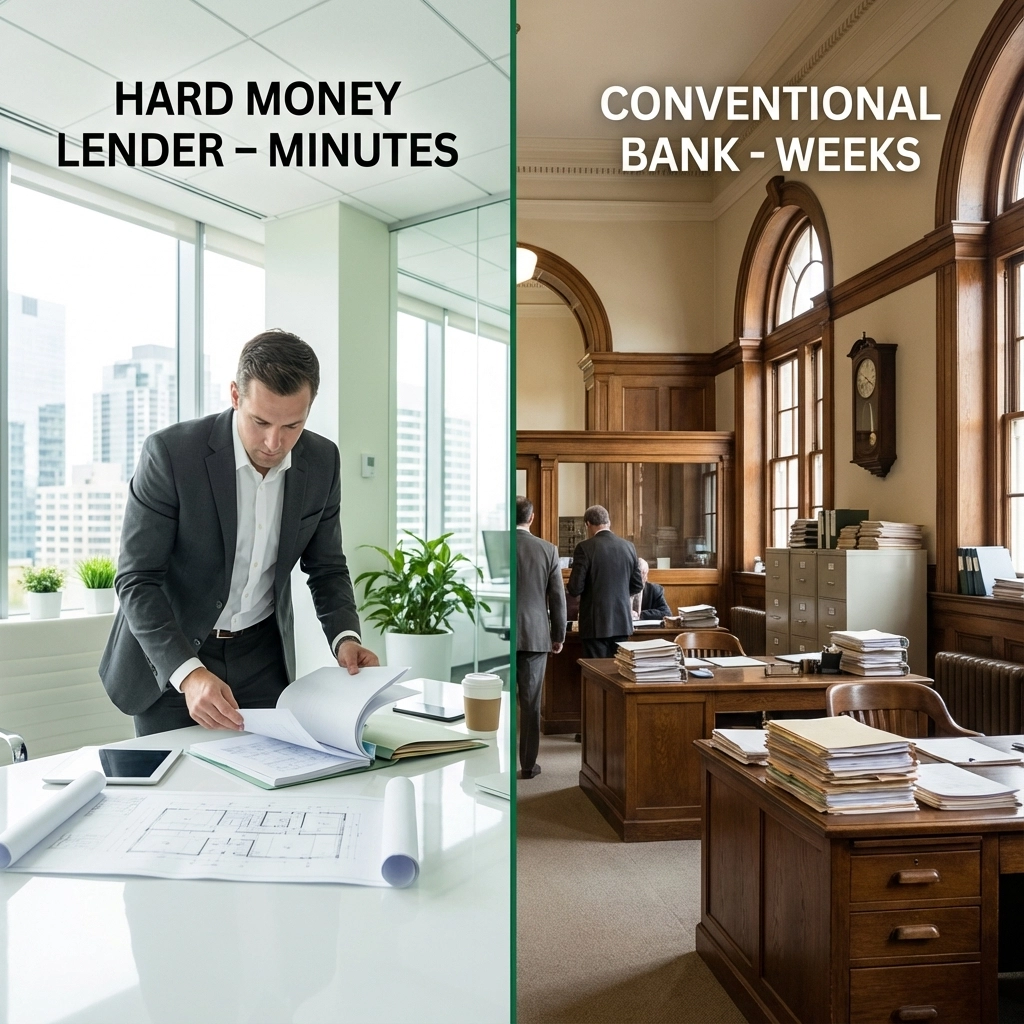
When you're competing against cash buyers (and let's face it, you usually are), speed isn't just nice to have: it's everything. Hard money lenders can get you approved and funded in 5-14 days, with some deals closing in as little as 4 days. Compare that to conventional loans that take 30-60+ days, and you'll see why serious flippers lean hard money.
I've seen investors lose out on great deals simply because they couldn't move fast enough with traditional financing. That perfect fixer-upper with solid profit margins? Gone to someone who could close in a week.
Property-First Underwriting
Here's where hard money really shines: they care more about the deal than your W-2s. Hard money lenders focus on the property's current value and after-repair value (ARV), not whether you've got perfect credit or can document every dollar of income.
Let's say you find a $200,000 property that needs $50,000 in rehab work. If comparable sales support a $350,000 ARV, a hard money lender might loan you 65-70% of that ARV: that's around $227,500-$245,000. This often means less money out of your pocket compared to conventional lenders who stick to strict loan-to-value ratios on the purchase price alone.
Flexibility That Works for Real Investors
Hard money lenders understand rehab projects. They'll structure loans with interest-only payments during construction, provide draw schedules that match your renovation timeline, and work with you on extensions if needed. Try getting that kind of flexibility from a bank.
Plus, hard money works for residential, commercial, and mixed-use properties, while conventional rehab loans typically limit you to single-family and small multi-family properties.
When Conventional Rehab Loans Make Sense
Lower Costs for the Long Game
If you're planning to hold a property for several years or considering a buy-and-hold strategy, conventional loans offer significantly lower interest rates and fees. We're talking rates that can be 5-10 percentage points lower than hard money.
The 15-30 year terms also mean much lower monthly payments, which is crucial if you're planning to rent the property after renovation.
Established Process with Predictable Rules
Conventional lenders follow standardized underwriting criteria, which means less guesswork about whether you'll qualify. If you meet their requirements, approval is pretty much guaranteed.
The Side-by-Side Breakdown
| Factor | Hard Money | Conventional Rehab |
|---|---|---|
| Approval Speed | 5-14 days | 30-60+ days |
| Interest Rates | 8-15%+ | 4-8% |
| Loan Terms | 6-24 months | 15-30 years |
| Credit Requirements | Flexible/None | Good credit required |
| Income Documentation | Not required | Full documentation |
| Maximum Loan Amount | Up to $3 million | ~$500k-$1 million |
| Property Types | Any investment property | Mainly residential |
| Down Payment | Often lower with ARV lending | Higher with purchase price focus |
| Rehab Budget Coverage | Full renovation costs | Limited rehab coverage |
| Monthly Payments | Interest-only options | Principal + interest |
Choosing Your Financing Strategy
Go Hard Money When:
- You need to close in under 30 days to compete
- You're self-employed or have irregular income
- Your credit isn't perfect (below 680)
- You're buying distressed properties needing major work
- You plan to flip within 6-18 months
- The property needs more than cosmetic repairs
- You want to scale quickly and do multiple deals
Choose Conventional If:
- You're buying a turnkey rental property
- You have W-2 income and excellent credit (720+)
- You plan to hold the property long-term
- Speed isn't critical to winning the deal
- The property needs minimal repairs
- You want the lowest possible monthly payments

Real-World Fix and Flip Scenarios
Scenario 1: The Competitive Market Flip
You find a 3-bedroom house listed at $180,000 that needs $40,000 in renovations. Comparable sales show an ARV of $280,000, giving you roughly $60,000 in profit potential. There are multiple offers expected.
Hard Money Advantage: You can make a strong offer with a 7-day close, beating out conventional buyers who need 30-45 days. Even at 12% interest for 8 months, your carrying costs are around $14,400: easily absorbed by your $60,000 profit margin.
Scenario 2: The Buy-and-Hold Conversion
You're considering a duplex for $250,000 that needs $30,000 in work. Your plan is to rent both units and hold long-term.
Conventional Advantage: Lower rates mean better cash flow. At 6% over 30 years versus 12% hard money, you're saving hundreds monthly in payments, which directly improves your rental income returns.
The Bottom Line for Fix and Flippers
Most successful fix and flip investors use hard money because it matches their business model perfectly. You're not looking to hold properties for 30 years: you need fast access to capital, quick closings, and the ability to renovate and sell within 6-18 months.
The higher interest costs are typically offset by:
- Faster deal execution and higher deal volume
- Ability to compete with cash buyers
- Access to deals that banks won't touch
- Interest-only payments that improve cash flow during rehab
Smart investors treat hard money interest as a business expense, just like contractor costs or materials. If a deal doesn't work with hard money rates, it probably wasn't a strong deal to begin with.
Ready to Fund Your Next Fix and Flip?
The right financing can make or break your real estate investing success. Whether you're leaning toward hard money for that quick competitive edge or considering conventional financing for a longer-term play, having the right lending partner makes all the difference.
At Emerald Capital Funding, we specialize in helping real estate investors like you secure the financing that matches your strategy and timeline. We understand the fix and flip business inside and out, and we're here to help you move quickly on great deals.
Ready to discuss your next project? Let's talk about how we can structure the perfect financing solution for your fix and flip goals. Don't let great deals slip away because of slow financing: reach out today and let's get you funded fast.