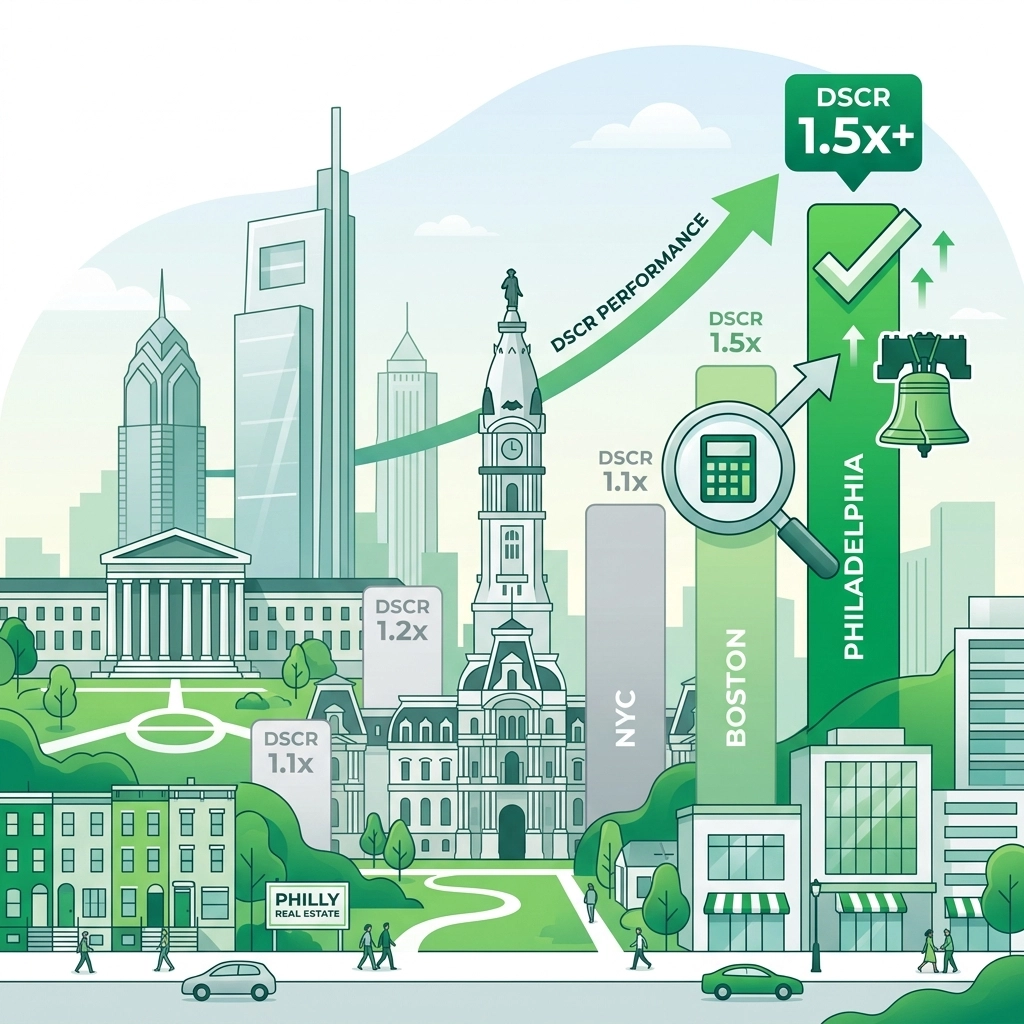

If you’re considering expanding your real estate portfolio along the I-95 corridor, you’ve likely noticed a frustrating trend. In cities like New York, Boston, and Washington D.C., property values have skyrocketed so high that finding a deal that actually "pencils out" for a DSCR loan is like searching for a needle in a very expensive haystack.
Welcome to the world of Philadelphia real estate lending, where the math actually starts making sense again. While the rest of the East Coast struggles with compressed yields and negative cash flow, Philly has quietly remained the "Goldilocks" zone for savvy investors. It’s a market where you can still find the perfect balance of affordable entry points and strong rental demand.
In this guide, we’re going to dive deep into the "Philly Math" that is driving a surge in DSCR loan Pennsylvania applications and show you how to leverage these ratios to scale your portfolio faster than you thought possible.
The DSCR Snapshot: Why the Ratio is King
Before we dive into the specific neighborhoods, let’s talk about the metric that makes or breaks your deal: the Debt Service Coverage Ratio (DSCR). For those who might be new to this, DSCR is a simple calculation used by lenders to determine if a property can pay for itself. We take the monthly rental income and divide it by the PITIA (Principal, Interest, Taxes, Insurance, and Association dues).
- A ratio of 1.0 means the property breaks even.
- A ratio of 1.2 or higher is the "sweet spot" where lenders get excited and your cash flow is protected.
In high-cost markets, achieving a 1.2 DSCR often requires a massive down payment: sometimes 40% or more: just to get the numbers to work. In Philadelphia, the lower cost of entry combined with high rental rates allows you to hit that 1.2+ mark with much less leverage, or even with a hard money loan Pennsylvania during the initial bridge phase.

Philly vs. The Neighbors: A Tale of Two Spreadsheets
To understand why Philadelphia’s DSCR ratios are outperforming the East Coast, we have to look at the math side-by-side. Let’s compare a typical investment property in Philadelphia to its neighbors in Brooklyn or D.C.
The Brooklyn Scenario:
- Purchase Price: $950,000 (for a modest 2-bedroom)
- Monthly Rent: $4,500
- The Problem: Once you factor in high property taxes and the mortgage on a nearly million-dollar property, your DSCR is likely hovering around 0.7 or 0.8. To get that to a bankable 1.2, you’d have to sink hundreds of thousands of dollars into a down payment, killing your ROI.
The Philly Math Scenario:
- Purchase Price: $275,000 (a renovated rowhome in a solid neighborhood)
- Monthly Rent: $2,100
- The Result: Because the debt service on $275,000 is significantly lower, your DSCR naturally sits higher: often north of 1.25.
With that said, the real magic happens when you realize that for the price of one single property in New York, you could potentially acquire three or four cash-flowing doors in Philadelphia. This is how you achieve financial security through diversification.
Actionable Takeaway:
When evaluating deals, don't just look at the total rent. Look at the "Rent-to-Price" ratio. In Philly, hitting the 0.8% to 1% rule is still very much a reality, whereas, in other Tier 1 East Coast cities, you’re lucky to hit 0.5%.
Stability Meets Opportunity: The "Eds and Meds" Factor
One reason investors often hesitate with lower-priced markets is the fear of instability. However, Philadelphia isn't just "cheap": it's stable. The city’s economy is anchored by the "Eds and Meds": massive educational and medical institutions like the University of Pennsylvania, Temple, and Drexel, along with world-class healthcare systems.
This creates a permanent, recession-resistant rental class. Whether it’s graduate students, traveling nurses, or young professionals working in biotech, the demand for high-quality rental housing in neighborhoods like University City, Fishtown, and South Philly remains relentless.
Once you’ve identified a property in these high-demand zones, you can use a DSCR loan to lock in long-term financing based solely on that property's income, rather than your personal tax returns.
How Emerald Capital Funding Simplifies the Scale
At Emerald Capital Funding, we understand that "Philly Math" works best when you can move quickly. Traditional banks are often bogged down by paperwork and "old school" underwriting that doesn't fit the modern investor's lifestyle. We’ve designed our process to be the wind in your sails, not the anchor holding you back.
Here is how we help you dominate the Philadelphia market:
- 90% LTC (Loan-to-Cost): We provide up to 90% of the purchase and renovation costs for your fix and flip secrets projects. This keeps your liquidity high so you can move on to the next deal.
- No Tax Returns Required: Our DSCR loans focus on the property's performance. We don't care about your W-2 or your personal debt-to-income ratio. If the property makes sense, the deal makes sense.
- Quick Funding: In the competitive Philly market, speed is a currency. We can often close in a fraction of the time it takes a traditional lender.
- Scaling Ready: Because we don't limit the number of properties you can have under finance (unlike Fannie/Freddie), you can build a massive portfolio using our capital.
The Strategy: The Philadelphia BRRRR
If you want to achieve your financial goals at an accelerated pace, the BRRRR method (Buy, Rehab, Rent, Refinance, Repeat) in Philadelphia is a powerhouse strategy.
- Step 1: Buy. Use a hard money loan Pennsylvania to snag a distressed rowhome in a path-of-progress neighborhood like Brewerytown or Port Richmond.
- Step 2: Rehab. Use our renovation capital to bring the property up to modern standards.
- Step 3: Rent. Secure a high-quality tenant thanks to Philly’s low vacancy rates.
- Step 4: Refinance. Transition into a long-term DSCR loan. Because the value has increased, you can often pull your initial capital back out.
- Step 5: Repeat. Use that same capital to buy your next Philly property.
With the right approach, you aren't just buying a house; you're building a cash-flow engine.

Q&A: Navigating Philadelphia Real Estate Lending
Q: Is Philadelphia a "landlord-friendly" city?
A: While Pennsylvania state laws are generally balanced, Philadelphia does have specific landlord requirements (like lead paint certifications and rental licenses). Don't worry, though; once you have your systems in place, these are just standard operating procedures that contribute to a higher quality of housing stock.
Q: What is the minimum DSCR ratio Emerald Capital Funding requires for Philly properties?
A: We typically look for a 1.20 DSCR to get the best rates, but we have programs that can go as low as 1.0 (break-even) or even lower in certain circumstances if the deal has strong merits.
Q: Do I need to live in Pennsylvania to get a DSCR loan there?
A: Not at all! We work with many out-of-state investors who live in high-cost areas like California or New York but invest in Philly because the math is so much better. We've got you covered no matter where you're based.
Q: How does 90% LTC work for a new investor?
A: If you have a solid deal and a clear exit strategy, we can fund 90% of your purchase and 100% of your renovation costs. This is a game-changer for investors looking to keep their cash in their pockets for the next opportunity.
Your Path to Financial Security Starts in Philly
The East Coast isn't closed for business; it's just shifted its focus. While others are overpaying for trophy assets in Manhattan, the real wealth is being built in the blocks of Philadelphia. Success is within your reach when you stop fighting the market and start following the math.
If you’re ready to see how "Philly Math" can transform your portfolio, we’re here to help. Whether you’re looking for a bridge loan to kick off a renovation or a long-term DSCR loan to lock in cash flow, Emerald Capital Funding has the tools you need to succeed.
Ready to see what you qualify for? Apply Now and let’s get your next Philly deal funded! Or, if you have questions about a specific property, feel free to contact us today. Your pathway to financial security is just one deal away.