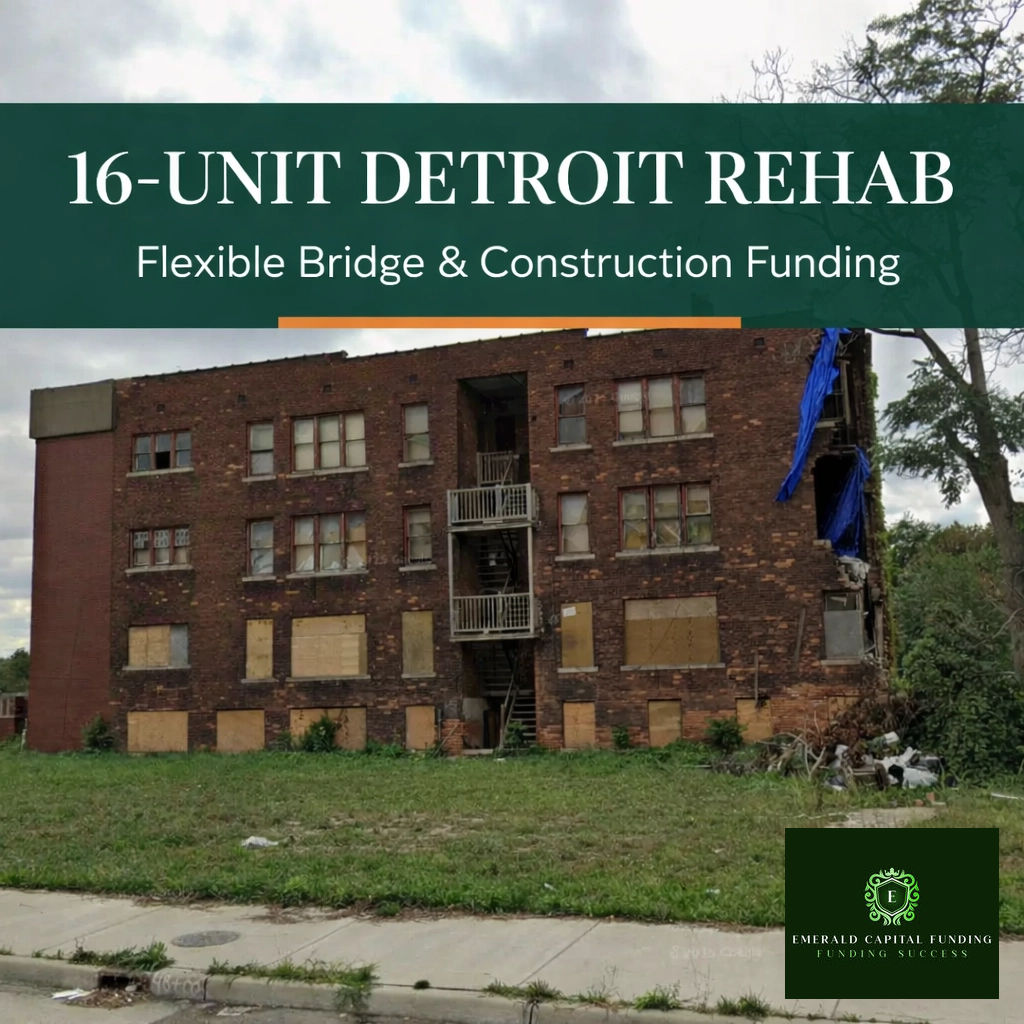

If you’re considering making a move into the multifamily space, you’ve probably heard a lot of noise about where the "smart money" is going. Welcome to the world of high-leverage commercial investing, where we stop looking at single-family houses and start looking at entire city blocks. I’m Bill Nicholson, and today I want to pull back the curtain on a recent project we funded in Detroit that perfectly illustrates how we do things differently here at Emerald Capital Funding.
We’re talking about a 16-unit building, a true "diamond in the rough", that needed a team with vision and a lender who wasn’t afraid of a little grit. While traditional banks were busy checking boxes and saying "no" because of the property's condition or the location's history, we were looking at the numbers and the potential for a massive transformation.
The Detroit Opportunity: Why the Motor City is Purring
Before we dive into the nitty-gritty of the loan, let’s talk about why Detroit is such a hotspot for investors right now. For years, Detroit was the city everyone loved to count out. But if you’ve been on the ground there lately, you know the narrative has changed. There is a massive revitalization happening, fueled by both massive corporate investment and grassroots neighborhood stabilization.
For an investor, Detroit offers something that’s getting harder to find in markets like Austin or Tampa: yield. You can still find substantial buildings at a cost basis that allows for significant "forced appreciation" through renovation. When you find a 16-unit building that has good "bones" but looks like a disaster on the surface, you aren't looking at a headache, you’re looking at a goldmine. This guide will equip you with the knowledge of how we view these deals so you can spot your own Motor City miracle.
The Challenge: Why Traditional Banks Walk Away
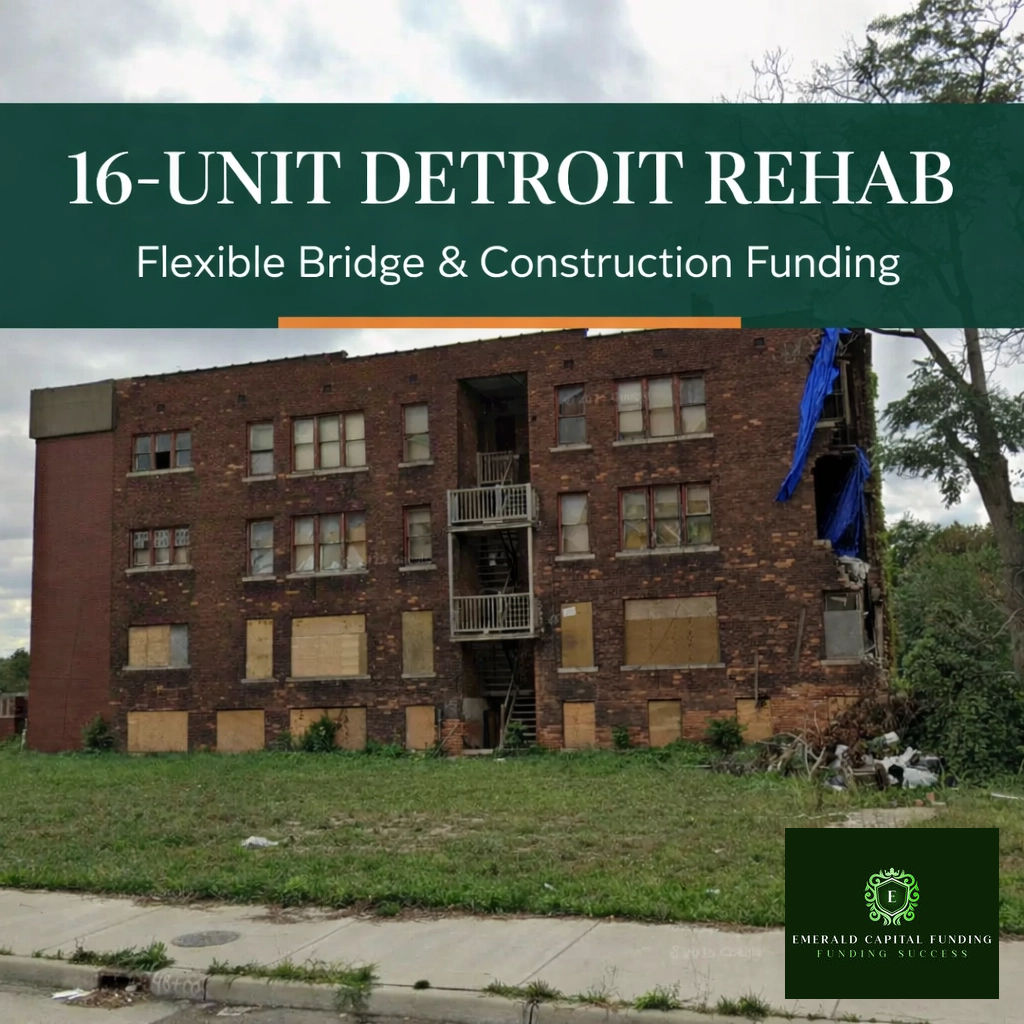
When our client brought us this 16-unit Detroit project, they had already hit a few brick walls. Most traditional lenders and local banks have a very rigid set of criteria. They want properties that are already stabilized, 90% occupied, and in pristine condition.
This building was none of those things. It needed a complete overhaul, new systems, roof work, and a total interior face-lift for every unit. Traditional banks see that as "too much risk." They see the 16 units and the heavy rehab and they head for the hills.
But at Emerald Capital Funding, we understand that the value isn't just in what the property is today, but what it will be once the dust settles. That’s where our specialized bridge-to-rehab construction loans come into play. We don't just look at the purchase price; we look at the total project cost.
The Secret Sauce: Understanding 90% LTC Math
The headline of this deal is the 90% LTC (Loan-to-Cost). If you’re used to putting down 20% or 25% on a property, 90% LTC might sound like a dream. But in the world of professional debt, it's a strategic tool.
LTC refers to the total amount we are willing to lend based on the purchase price plus the renovation budget. For this 16-unit Detroit deal, we funded 90% of the total cost. This meant the investor was able to keep a massive amount of their own capital in their pocket to use for other deals or as a safety net.
If you want to dive deeper into how this math works, check out our guide on fix and flip secrets revealed: the LTC math expert lenders use.
Actionable Takeaway: When scaling to 16 units, your cash is your most valuable resource. Using a 90% LTC bridge loan allows you to control a multimillion-dollar asset with a relatively small down payment, maximizing your Return on Equity (ROE).

Scaling Up: When You Cross the Commercial Line
There’s a big psychological jump when you move from 4 units (residential) to 5+ units (commercial). Once you hit 16 units, the rules of the game change. You’re no longer just a landlord; you’re a business operator.
The beauty of a 16-unit building is the economy of scale. You have one roof, one plot of land, and 16 streams of income. If one tenant moves out, your occupancy only drops by 6%. If a tenant moves out of a duplex, you’re 50% vacant. See the difference?
We specialize in multifamily DSCR loans for 5+ units, and we helped this investor understand how the valuation of their Detroit property would shift from "comparable sales" to "Net Operating Income (NOI)." By renovating the units and raising the rents to market rates, the investor isn't just making the building prettier, they are exponentially increasing its appraised value.
The Strategy: Bridge-to-Rehab to Long-Term Wealth
The path to success with a deal like this follows a specific, logical progression:
- Acquisition & Rehab: Use a bridge loan to secure the property and fund the construction.
- Execution: Complete the renovations on time and on budget (check out these common fix-flip mistakes to stay on track).
- Lease-Up: Get those 16 units filled with qualified tenants.
- The Exit: Once the building is stabilized and the value has "popped," you refinance out of the bridge loan and into a long-term, low-interest DSCR loan.
This is essentially a "BRRRR" strategy on steroids. We call it the 90-day BRRRR timeline, though with 16 units, the rehab might take a bit longer. The goal remains the same: pull your original investment back out and hold the asset for long-term cash flow.

Q&A: Your Detroit Multifamily Questions Answered
Q: Is Detroit really safe for a large-scale investment?
A: Like any major city, Detroit is block-by-block. We look at the specific neighborhood data. The areas where we are seeing 16-unit buildings being renovated are often seeing massive "path of progress" momentum. With the right local property management, these assets are performing incredibly well.
Q: Why would Emerald Capital Funding offer 90% LTC when a bank won't?
A: We are asset-based lenders. We care more about the property’s potential and your experience than your personal tax returns. We’ve got you covered because we understand the real estate, not just the paperwork. You can learn more about why your tax returns don't matter for DSCR qualification here.
Q: What happens if the rehab costs go over budget?
A: Don't worry, we build contingency plans into our loans. However, we always recommend having a "rainy day" fund. The goal of the 90% LTC is to keep your cash liquid so you can handle those unexpected "Detroit surprises" that old buildings sometimes throw at you.
Q: Do I need a different loan for the rehab versus the purchase?
A: Nope! We wrap them into one "Bridge-to-Rehab" product. It’s one closing, one set of fees, and a whole lot less stress. Check out our loan cheat sheet to see which one fits your next deal.
Your Path to Scaling Big
Success in real estate is within your reach, but it requires the right leverage. This 16-unit Detroit deal is proof that you don't need to have millions in the bank to take down large-scale commercial projects. You just need a solid plan, a great property, and a lending partner like Emerald Capital Funding that understands how to bridge the gap between "as-is" and "stabilized."
Actionable Takeaways for Your Next Deal:
- Look for "un-bankable" deals: Properties that need work often have the highest upside.
- Focus on the LTC: Prioritize high-leverage loans that preserve your cash for renovations and reserves.
- Think in Units: If you can do a 4-unit, you can do a 16-unit. The systems are similar, but the rewards are much higher.
- Partner with experts: Work with lenders who know the Detroit market and understand multifamily dynamics.

Ready to Fund Your Own "Diamond in the Rough"?
Whether you’re looking at a 16-unit building in Detroit or a 5-unit apartment in your own backyard, we’re here to help you navigate the financing. At Emerald Capital Funding, we don't just provide capital; we provide the strategy you need to scale your portfolio and achieve your financial goals.
Don't let a "no" from a traditional bank stop your momentum. Let’s talk about your next project and see if we can get you that 90% LTC you need to make the numbers work.
Contact Bill Nicholson and the Emerald Capital Funding team today!
Let’s turn that "diamond in the rough" into your next powerhouse asset. With the right approach and the right funding, your pathway to financial security is closer than you think. Together, we’ve got this!