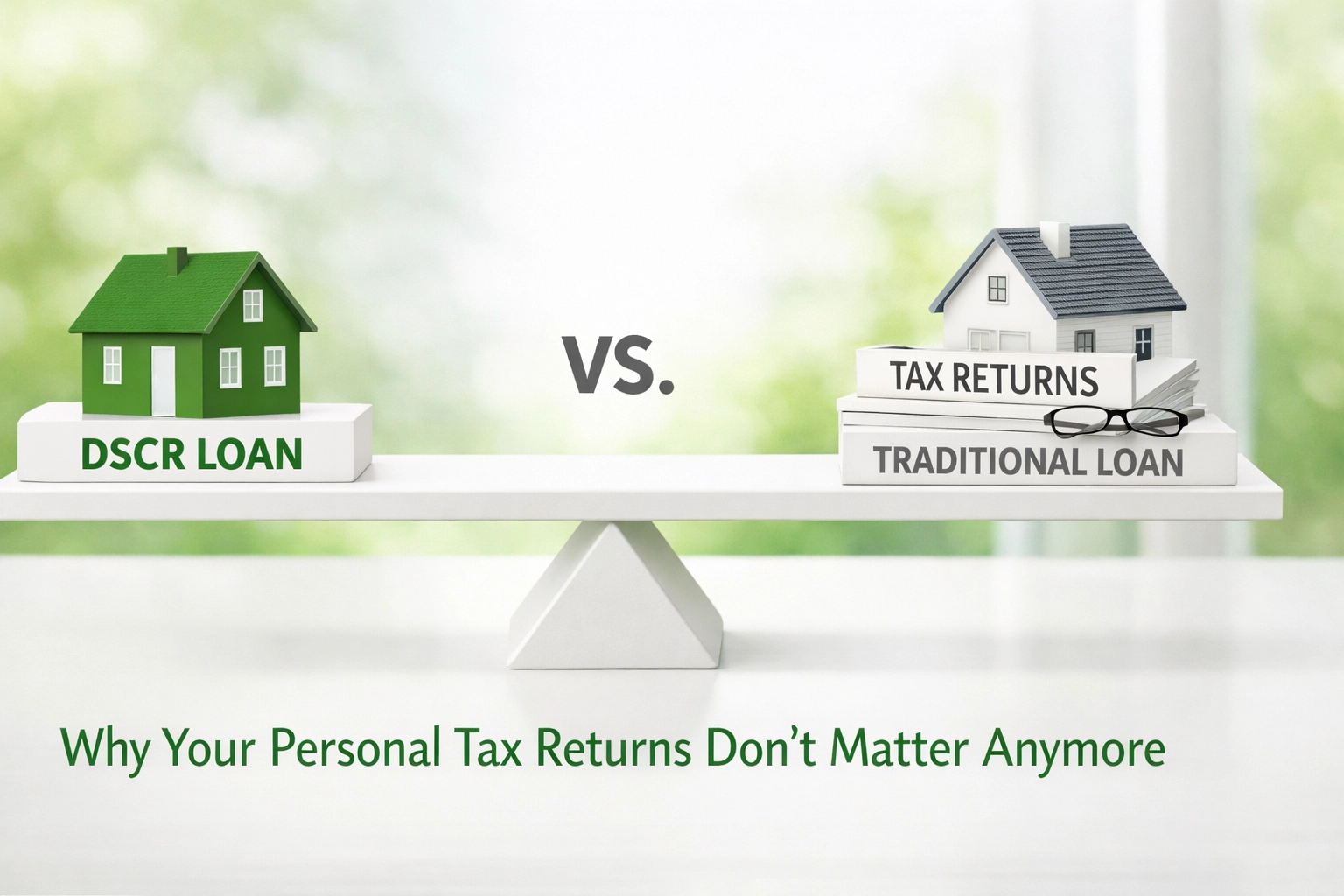

If you’re considering growing your real estate portfolio, you’ve likely hit a wall at a traditional bank. You walk in with a solid property, a great track record, and a plan to scale, only to have a loan officer tell you that your "debt-to-income ratio" is too high because your accountant did a great job with your tax write-offs.
Welcome to the world of investor-focused lending, where we care more about the deal than your 1040s. At Emerald Capital Funding, we’ve seen countless investors get stuck in the "tax return trap." Today, I’m going to pull back the curtain on why personal tax returns are becoming a thing of the past for serious real estate professionals and how Debt Service Coverage Ratio (DSCR) loans are the key to unlocking your next level of growth.
The Traditional Lending Wall: Why W-2 Logic Fails Investors
Traditional mortgages were designed for people with steady, predictable paychecks, the classic W-2 employee. When you apply for a conventional loan, the bank looks at your personal income, subtracts your personal debts, and calculates your Debt-To-Income (DTI) ratio.
For a self-employed real estate investor, this is a nightmare. You might be "rich" in cash flow and equity, but on paper, your taxable income looks low because you’re smart enough to use depreciation, interest deductions, and business expenses to lower your tax liability. The bank sees a low bottom line on your tax return and sees "risk," whereas we see a savvy business owner.
This is where DSCR loans explained come into play. Instead of looking at you, we look at the asset.

What Exactly is a DSCR Loan?
A Debt Service Coverage Ratio (DSCR) loan is a type of commercial-style loan for residential (1-4 unit) or small multi-family (5+ unit) investment properties. The "magic" of this product is that it measures the ability of the property to pay for itself.
The lender calculates the ratio by taking the property’s gross monthly rent and dividing it by the monthly debt obligations (Principal, Interest, Taxes, Insurance, and sometimes HOA fees, often referred to as PITI).
The Simple Formula:
- Gross Monthly Rent / Monthly PITI = DSCR
If your rental income is $2,500 and your total mortgage payment is $2,000, your DSCR is 1.25. In the eyes of an investor-focused lender, that property is healthy because it covers its own debt and has a 25% cushion. This guide will equip you with the knowledge to stop worrying about your personal salary and start focusing on the numbers that actually matter: the property's performance.
Why Your Personal Tax Returns Don’t Matter Anymore
When you work with Emerald Capital Funding for a DSCR loan, we don't ask for two years of tax returns. We don't ask for W-2s or pay stubs. We don’t even care about your DTI. Here is why this is a game-changer:
- High Write-Offs? No Problem: You can continue to minimize your tax burden without worrying that it will prevent you from buying your next three rental properties.
- Infinite Scalability: Traditional banks usually cap you at 10 loans. With DSCR, as long as the properties cash flow and you have the down payment, you can keep going.
- Speed to Close: Because we aren't digging through hundreds of pages of personal financial history, the underwriting process is significantly faster.
- No Employment Verification: Whether you are full-time in real estate, recently switched jobs, or are technically "unemployed" while living off your portfolio, you can still qualify.
For a deeper dive into this, check out our piece on DSCR qualification truth: why your tax returns don’t matter but your property does.

The Math of a Winning Deal: The 1.0 vs. 1.25 Rule
In the world of DSCR, the ratio is king. While every lender has slightly different "appetites," here is the general breakdown of how the numbers affect your loan terms:
- 1.25 or Higher: This is the gold standard. You’ll typically get the best interest rates and the highest leverage (up to 80% LTV).
- 1.0 to 1.24: The property is still "covering," but the cushion is thinner. You can still get funded, but you might see a slightly higher rate or a requirement for a larger down payment.
- Below 1.0 (No-Ratio): Believe it or not, some DSCR programs allow for "no-ratio" loans where the property doesn't even have to break even on paper. This is perfect for properties in high-appreciation areas where rents are currently low but the upside is huge.
With that said, most serious investors aim for a 1.20+ ratio to ensure they are building a resilient portfolio that can survive market fluctuations.
Transitioning from 4 Units to 5+ Units
Once you’ve mastered the 1-4 unit space using DSCR loans, you’ll eventually want to "level up." This is where the financing changes slightly. When you cross into 5+ units, you are firmly in commercial territory.
While the DSCR principles remain the same, the underwriting becomes even more focused on the business operations of the building. Understanding multifamily DSCR loans (5 units+): what changes when you cross the commercial line is vital for anyone looking to go from "landlord" to "apartment owner."

Comparing the Options: Traditional vs. DSCR
If you’re still on the fence, let’s look at a quick side-by-side comparison.
| Feature | Traditional Mortgage | DSCR Loan (Emerald Capital) |
|---|---|---|
| Income Verification | Tax Returns, W-2s, Paystubs | Rental Income Only |
| Debt-to-Income (DTI) | Primary Factor (usually <43%) | Not Considered |
| Closing Speed | 45-60 Days | 21-30 Days |
| Loan Limit | Usually capped at 10 | Unlimited |
| Interest Rates | Lower | Slightly Higher (0.5% – 1.5%+) |
| Property Type | Primary/Secondary/Investment | Investment Only |
While the interest rate on a DSCR loan might be a point or two higher than a conventional loan, the trade-off is the ability to actually get the deal done and scale your business without a bank breathing down your neck about your personal spending habits.
Q&A: Common Questions About DSCR Loans
Q: Do I still need a good credit score for a DSCR loan?
A: Yes. While we don't look at your income, your credit score is still an indicator of how you manage debt. Higher scores usually unlock lower rates and higher LTVs. Generally, you want to be above 660, though we can work with scores lower than that in some cases.
Q: Can I use a DSCR loan for a Fix and Flip?
A: Not usually. DSCR loans are for long-term "hold" properties that are already tenant-occupied or ready for rent. If you need money for a renovation, you should look into bridge loans simplified or fix-and-flip secrets.
Q: Are there prepayment penalties?
A: Most DSCR loans do have a prepayment penalty (often a 3-2-1 or 5-4-3-2-1 structure). This is because these are long-term investment vehicles. If you plan to sell in 12 months, this might not be the right product for you.
Q: Can I close in an LLC?
A: Absolutely. In fact, most of our clients prefer to close in an LLC for asset protection. Unlike conventional loans, which often require you to close in your personal name, DSCR loans are built for corporate entities.

Actionable Takeaways for Your Next Deal
If you’re ready to stop playing the "tax return game" with big banks, here are your next steps:
- Calculate your current portfolio’s DSCR: See where you stand. Are your properties performing at a 1.25 or higher?
- Organize your LLC docs: Since you’ll likely be closing in an entity, make sure your Operating Agreement and EIN are ready to go.
- Run the numbers on a new deal: Use the gross rent (check AirDNA for short-term or Rentometer for long-term) and divide it by the estimated PITI.
- Reach out to a specialist: Don't talk to a "retail" loan officer at a local branch. You need an expert who understands the nuances of investor debt.
Why Every Serious Investor Needs This Tool
At the end of the day, real estate is a game of leverage and speed. If you are waiting on a conventional bank to approve your 100-page tax transcript, you’re going to lose the deal to an investor using a bridge or DSCR product.
We've helped investors scale from their first duplex to 50+ unit portfolios by simply removing the friction of personal income verification. Whether you are doing a Buffalo BRRRR or scaling big in Detroit, the logic remains the same: the property is the business.
Ready to see what your property can do for you?
Don’t let your tax returns hold your portfolio hostage. At Emerald Capital Funding, we specialize in helping you leverage the power of the property to build lasting wealth. Your pathway to financial security shouldn't be blocked by a W-2 requirement.
Contact Emerald Capital Funding today and let’s get your next deal funded without the tax return headache.