Multi Family 5 Units or More 101: A Beginner’s Guide to Mastering Commercial Loans

Welcome to the world of big-league real estate! If you’re reading this, you’ve likely already dipped your toes into the residential rental market. Maybe you own a few single-family homes or a duplex, and you’re starting to realize that managing ten different houses in ten different locations is a logistical headache. You’re ready to scale, and that means looking at properties with multi family 5 units or more.

But here’s the catch: once you hit that fifth unit, the rules of the game change entirely. You aren't just buying a bigger house; you're buying a business. At Emerald Capital Funding, we see investors make this jump every day, and while it feels like a giant leap, we’ve got you covered. This guide will equip you with everything you need to transition from residential thinking to mastering commercial loans.

Why the Number Five Changes Everything

In the eyes of the lending world, there is a massive wall between a four-unit property and a five-unit property. Anything with one to four units is considered "residential." You can often snag these with a 30-year fixed mortgage, lower down payments, and loans backed by Fannie Mae or Freddie Mac.

Once you add that fifth unit, you cross over into the realm of commercial real estate. Why does this matter? Because commercial loans are structured differently, priced differently, and evaluated differently. You’re no longer being judged solely on your personal salary as a software engineer or a nurse; you’re being judged on how well that building can "work" for a living.
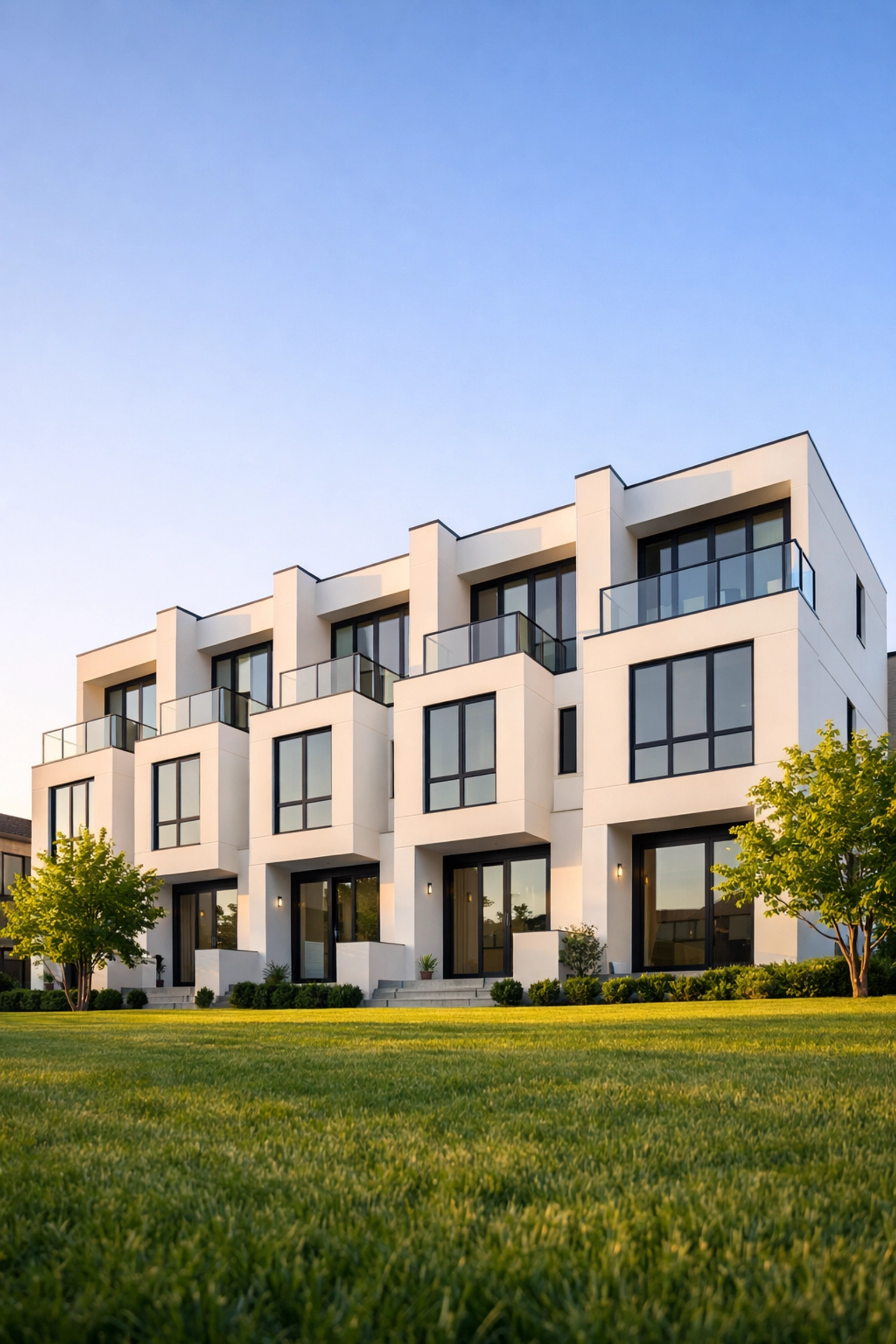
Modern multi family 5 units or more apartment building representing a profitable commercial real estate investment.

The Big Mindset Shift: It’s About the Property’s Paycheck

If you’ve bought a home before, you know the drill: the lender wants your W-2s, your tax returns, and a deep look at your personal Debt-to-Income (DTI) ratio. They want to know if you make enough money to pay the mortgage.

When you move into multi family 5 units or more, the focus shifts from you to the building. This is often referred to as a "DSCR-ish" approach, but on a much larger scale. Lenders care about the Net Operating Income (NOI). They ask: "After paying for water, taxes, insurance, and the super, is there enough money left over to pay the bank?"

Actionable Takeaway: Focus on the T12

Before you even talk to a lender, ask the seller for the "T12": the trailing 12 months of profit and loss. This is the property’s resume. If the T12 shows consistent income and managed expenses, your path to a commercial loan becomes much smoother.

Understanding the Numbers: LTV vs. LTC

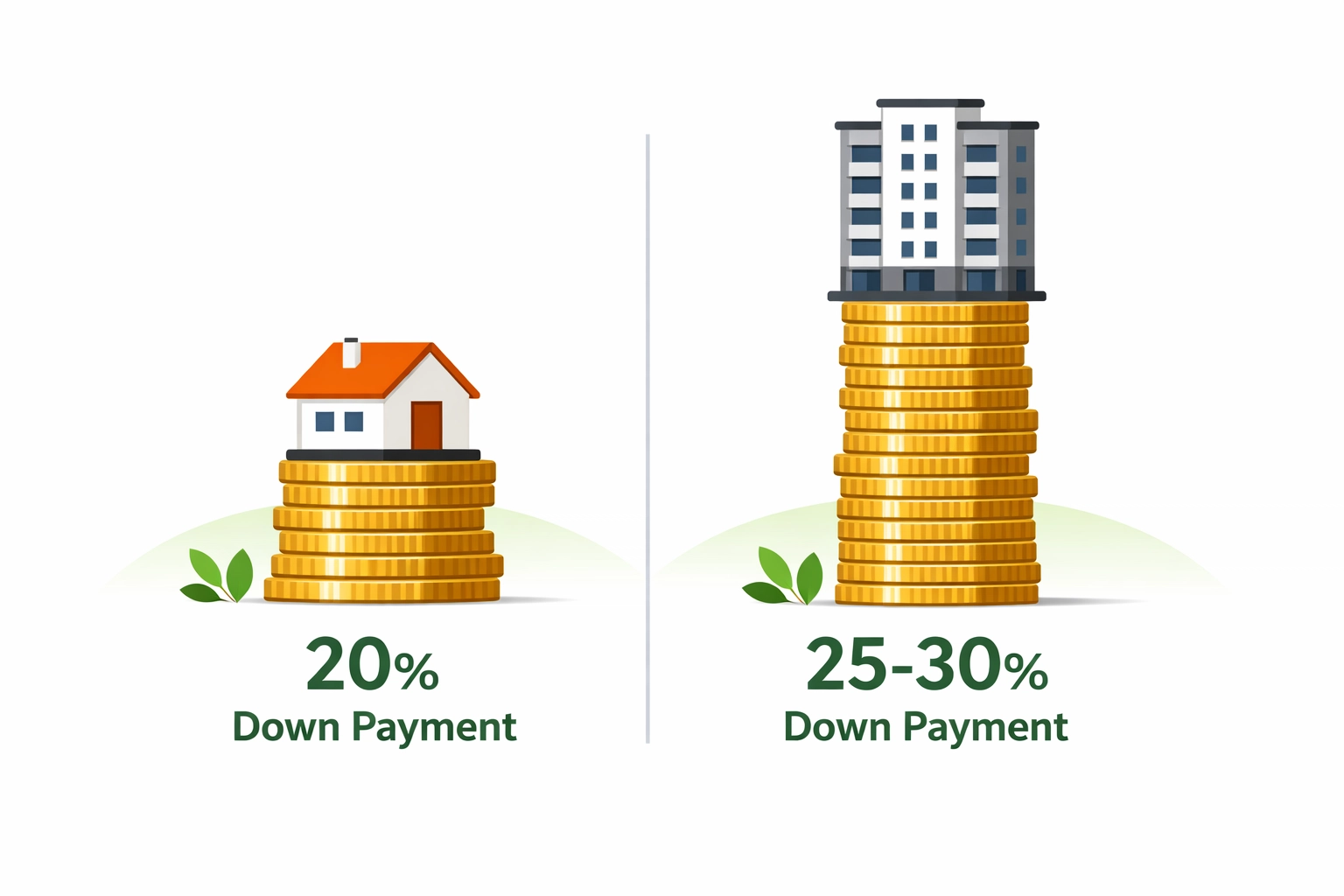
In the residential world, you might be used to putting 3.5% or 5% down. In commercial lending, you’ll need to bring a bit more "skin to the game." Generally, you should expect to contribute approximately 25% of the property's value as a down payment.

Lenders look at two main ratios:

  1. Loan-to-Value (LTV): This is the percentage of the property’s current appraised value the bank will lend. For a solid multi-family deal, you’re usually looking at 75% to 80% LTV.
  2. Loan-to-Cost (LTC): If you are buying a "fixer-upper" apartment complex, the lender looks at the total project cost (purchase price + renovation budget). We often provide up to 90% LTC financing to help investors keep their cash liquid for other deals.

Success is within your reach if you plan for these capital requirements early. You can check out our services page to see how we structure these different ratios.

What Commercial Lenders Are Actually Looking For

Don’t worry; you don't need to be a billionaire to get a commercial loan, but you do need to show "Sponsor Strength." While the building’s income is the star of the show, the lender still needs to know who is behind the curtain.

  • Credit Score: Usually, a 650 or higher is the baseline.
  • Liquidity: Lenders want to see that you have "post-closing liquidity." They don't want you to spend your last dollar on the down payment. They like to see that you have enough cash in the bank to cover 6-12 months of mortgage payments just in case of emergencies.
  • Experience: If this is your first 10-unit building, a lender might want to see that you’ve managed smaller rentals before or that you’ve hired a professional property management company.

Professional handshake in a modern office symbolizing a successful partnership for multi family commercial loans.

The Documentation Deep Dive

One of the biggest hurdles for beginners is the sheer amount of paperwork. Commercial underwriting is thorough. To stay ahead of the game, start gathering these documents now:

  1. The Rent Roll: A list of every unit, who lives there, how much they pay, and when their lease ends.
  2. Property Photos: High-quality images of the exterior, common areas, and at least a few unit interiors.
  3. The Offering Memorandum (OM): If you’re buying through a broker, they’ll provide this. It’s basically a marketing package for the property.
  4. Schedule of Real Estate Owned (SREO): A spreadsheet of every other property you own and how they are performing.

Having these ready when you apply now will set you apart as a professional investor rather than a hobbyist.

Choosing the Right Loan for Your Strategy

Not all commercial loans are created equal. Your choice depends on your "exit strategy."

  • Permanent Loans: These are for the "buy and hold" investor. They usually have terms of 5, 7, or 10 years with a 25- or 30-year amortization schedule.
  • Bridge Loans/Hard Money: If the building is currently empty or needs major repairs, a traditional bank won't touch it. You’ll need a bridge loan to buy it and fix it up before "refinancing out" into a permanent loan.
  • Agency Loans (Fannie/Freddie): These offer the best rates but have very strict requirements regarding the property’s condition and your own net worth.

Actionable Takeaway: Know Your Timeline

If you plan to flip the building in two years, don't get locked into a 10-year loan with a heavy prepayment penalty. Always match your financing to your business plan.

Architectural model and blueprints showing a strategic business plan for financing multi family 5 units or more.

Common Pitfalls to Avoid

Scaling to multi family 5 units or more is an exciting pathway to financial security, but watch out for these rookie mistakes:

  • Underestimating Expenses: In residential, you might just think about taxes and insurance. In commercial, you have to account for vacancy rates (usually 5%), property management fees (8-10%), and "CAPEX" (saving for that roof that will eventually leak).
  • Ignoring Zoning: Just because a building has five doors doesn't mean it’s legally zoned for five units. Always verify the Certificate of Occupancy.
  • Going It Alone: Commercial real estate is a team sport. You need a good lender, a solid contractor, and a sharp accountant.

Q&A: Common Questions for Commercial Beginners

Q: Can I use a commercial loan to buy a property I want to live in?
A: Generally, no. Commercial loans are for investment properties. If you plan to "house hack" a 5-unit building, you might still qualify for certain programs, but the underwriting will still focus on the business aspect of the property.

Q: Is the interest rate higher than a home loan?
A: Often, yes. Because commercial loans are considered higher risk for the bank, the rates are typically 0.5% to 2% higher than a standard 30-year residential mortgage. However, the tax benefits and cash flow of a larger building usually more than make up for the difference.

Q: How long does it take to close?
A: While a home loan can close in 30 days, commercial deals usually take 45 to 60 days. There are more "moving parts," like environmental reports and commercial appraisals.

Well-maintained courtyard of a multi family property showcasing quality commercial real estate management and scaling.

Your Pathway to Scaling

Moving into the 5-unit+ space is how real wealth is built in this industry. It allows you to use "economies of scale": fixing one roof over ten tenants is much cheaper than fixing ten roofs over ten tenants.

At Emerald Capital Funding, we specialize in helping investors bridge that gap. Whether you're looking for your first 5-unit apartment or you're looking to sell an auto loan portfolio to gain more liquidity, we’re here to help you navigate the complexities of the commercial market.

With the right approach and a solid team behind you, mastering commercial loans is entirely within your reach. Ready to see what your numbers look like?

Contact us today or jump straight into the process by visiting our application page. Let’s get your next deal funded!


Conventional Loan Rehab vs. Hard Money: Which Is Better For Your 2026 Project?

If you're considering jumping into a fix-and-flip or a major renovation project this year, welcome to the world of 2026 real estate. The market has moved fast, and the way we fund deals has evolved right along with it. One of the most common questions we get here at Emerald Capital Funding is a classic: "Should I go with a conventional loan rehab or stick with hard money?"

It’s a great question, and honestly, the "right" answer depends entirely on your goals, your timeline, and how much red tape you’re willing to cut through. Whether you’re a seasoned pro or just starting your first project, this guide will equip you with the knowledge to choose the financing that keeps your profit margins healthy and your stress levels low.

The Core Difference: Speed vs. Savings

Before we dive into the nitty-gritty, let’s set the stage. In the 2026 lending landscape, the gap between traditional banking and private lending has never been wider.

A conventional loan rehab (think Fannie Mae Homestyle or FHA 203k) is essentially a long-term mortgage that includes a "bucket" of money for repairs. It’s designed for stability. On the other hand, hard money is a short-term, asset-based bridge loan designed for speed and flexibility.

At Emerald Capital Funding, we see the fix-and-flip crowd leaning heavily toward hard money because, in this market, "slow" usually means "lost deal." But let’s break down the specifics so you can see where your project fits.

White stopwatch on home blueprints representing fast hard money loan closing times for real estate investors.

What Exactly Is a Conventional Loan Rehab?

When people talk about a conventional loan rehab, they are usually referring to a loan product that allows a borrower to purchase a home and renovate it using a single mortgage. These are backed by government-sponsored enterprises like Fannie Mae or Freddie Mac.

The Benefits of Going Conventional

  1. Lower Interest Rates: This is the big winner. Conventional rates in 2026 hover around 6-8%, which is significantly lower than the double-digit rates often seen in private lending.
  2. Longer Terms: You aren't rushed. You typically have a 15- or 30-year term, making this a "one-and-done" loan if you plan to keep the property as a long-term rental or a primary residence.
  3. Predictability: Your payments are amortized, meaning you’re paying down the principal from day one.

The Downsides (The "Red Tape" Factor)

  • The 45-Day Wait: Conventional loans are notorious for their slow processing times. You're looking at 30 to 45 days (at best) to close.
  • Strict Qualifications: You’ll need a FICO score of 620 minimum, but to get those "pretty" rates, you really need a 720+. You also have to provide years of tax returns, W-2s, and bank statements.
  • The "Livable" Requirement: Many conventional rehab products have strict rules about how "trashed" a house can be. If the property is missing a kitchen or has structural issues that make it uninhabitable, a traditional bank might run for the hills.

Actionable Takeaway: Use a conventional loan rehab if you are a buy-and-hold investor with a 700+ credit score and a property that only needs cosmetic "lipstick" repairs.

Why Hard Money is the 2026 Real Estate Power Move

If you’ve ever lost a bid because a "cash buyer" beat you to the punch, you already understand the value of speed. Hard money is essentially "proxy cash." It allows you to compete with those big-money hedge funds because you can close in a fraction of the time.

Why Investors Love It

  1. Lightning Speed: While the bank is still looking for your 2024 tax returns, a hard money lender can fund your deal in 3 to 7 days.
  2. Asset-Based Underwriting: We care more about the property than your personal income. If the deal makes sense and the After Repair Value (ARV) is strong, we’re interested. This is perfect for investors with non-W-2 income or those who have reached their limit on conventional loan counts.
  3. 90% LTC Financing: At Emerald Capital Funding, we offer up to 90% Loan-to-Cost (LTC). This means you keep more of your own cash in your pocket to scale your business. Check out our services page to see how we structure these deals.

The Trade-Offs

  • Higher Rates: Expect to pay between 10% and 13% in 2026. However, since these are short-term (usually 6-12 months), the total interest paid is often worth the speed of the transaction.
  • Interest-Only Payments: Most hard money loans are interest-only. While this helps your monthly cash flow during the renovation, it means you aren't paying down the loan balance.

Modern house model with a green door representing asset-based lending for investment property projects.

Comparing the Qualification Requirements

One of the biggest hurdles in 2026 is the documentation required by traditional institutions. If you've been self-employed for less than two years or have a complex tax situation, the conventional loan rehab path can feel like a part-time job just to get approved.

Feature Conventional Rehab Hard Money (Emerald Capital)
Close Time 30-60 Days 5-10 Days
Credit Score 620+ (Higher is better) 600+ (Flexible)
Income Verification Full Tax Returns/W-2s Primarily Property Value (ARV)
Renovation Budget Heavily Scrutinized Integrated into Draw Schedule
Down Payment 3.5% – 20% 10% – 20% of Cost

As you can see, hard money is built for the "hustle." It’s designed for the investor who finds a deal on Monday and needs to own it by next Friday. If you're ready to move that fast, you can apply now to get the ball rolling.

The 2026 Strategy: The "Hybrid" Approach

With that said, you don't always have to pick just one. Many of the most successful investors we work with use a "Hybrid Strategy."

They use Hard Money to acquire the property and fund the construction. Why? Because it’s fast and they can get the "ugly" house that a bank won't touch. Once the property is renovated, stabilized, and has a tenant in place, they refinance that hard money loan into a long-term DSCR loan or a conventional mortgage.

This strategy allows you to:

  1. Win the deal with speed.
  2. Force appreciation through renovation.
  3. Lock in a lower, long-term rate once the "risk" of construction is gone.

If you’re curious about how that second step works, our guide on DSCR loans explained breaks down exactly how to transition from a flip to a long-term rental.

Stunning renovated living room highlighting the high-value result of a successful fix and flip project.

Managing Your Rehab Budget and Draw Schedules

One often overlooked detail is how you actually get the money for the repairs.

With a conventional loan rehab, the bank often manages the contractor payments directly. This can lead to delays and "inspector fatigue," where your project stalls because the bank hasn't sent an inspector out to verify the drywall is up.

Hard money lenders, especially those who specialize in fix-and-flips, understand that time is money. At Emerald Capital Funding, our draw process is streamlined. We want you to finish the project as fast as possible so you can sell it and move on to the next one. We provide structured rehab funding that aligns with your project milestones, not a bureaucratic calendar.

Q&A: Your Burning Financing Questions

Q: Can I use a conventional loan rehab for a property I don't plan to live in?
A: Yes, products like the Fannie Mae Homestyle allow for investment properties, but expect higher down payment requirements (often 15-25%) and stricter interest rates compared to owner-occupied loans.

Q: Does hard money require a lot of paperwork?
A: Not compared to a bank! While we still need to verify who you are and see your experience level, we aren't going to spend three weeks digging through your 1099s from five years ago. We focus on the deal's merit.

Q: What happens if my project takes longer than 12 months?
A: Most hard money loans have a 6- to 12-month term. However, many lenders (including us) offer extension options if you hit unforeseen delays, like waiting on city permits.

Q: Is there a prepayment penalty on hard money?
A: Generally, no. Most hard money loans are designed to be paid off early. This is a huge advantage for flippers who finish a project in 4 months and want to stop paying interest immediately.

Business handshake in a modern office symbolizing a successful real estate lending agreement and partnership.

Final Thoughts: Which One Wins?

In the battle of conventional loan rehab vs. hard money, there isn't a single winner: only a winner for your specific situation.

  • Choose Conventional if you have plenty of time, great credit, and you’re looking for the absolute lowest interest rate for a long-term hold.
  • Choose Hard Money if you’re looking to scale, need to close fast, or are tackling a property that needs significant structural work.

At Emerald Capital Funding, we’ve got you covered with the speed and expertise you need to dominate the 2026 market. We know that every day a house sits empty is a day you’re losing money. Our mission is to provide the capital that lets you act like a cash buyer while keeping your liquidity intact.

Ready to see what we can do for your next project? Whether it's a single-family flip or a multi-family renovation, we're here to help you cross the finish line.

Contact us today to discuss your project, or if you’ve already found "the one," apply now and let's get to work!

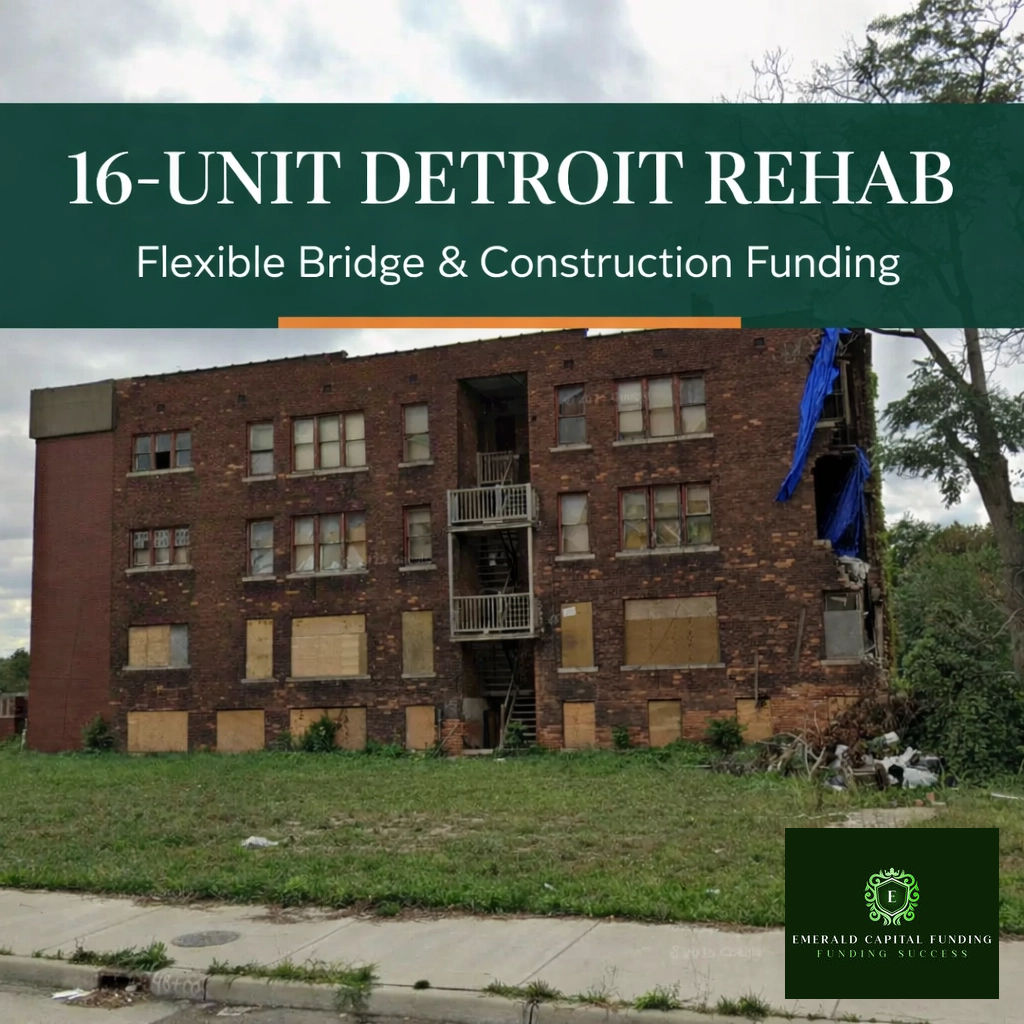
Real Deal Highlight: Scaling Big in Detroit – 16 Units and 90% LTC

If you’re considering making a move into the multifamily space, you’ve probably heard a lot of noise about where the "smart money" is going. Welcome to the world of high-leverage commercial investing, where we stop looking at single-family houses and start looking at entire city blocks. I’m Bill Nicholson, and today I want to pull back the curtain on a recent project we funded in Detroit that perfectly illustrates how we do things differently here at Emerald Capital Funding.

We’re talking about a 16-unit building, a true "diamond in the rough", that needed a team with vision and a lender who wasn’t afraid of a little grit. While traditional banks were busy checking boxes and saying "no" because of the property's condition or the location's history, we were looking at the numbers and the potential for a massive transformation.

The Detroit Opportunity: Why the Motor City is Purring

Before we dive into the nitty-gritty of the loan, let’s talk about why Detroit is such a hotspot for investors right now. For years, Detroit was the city everyone loved to count out. But if you’ve been on the ground there lately, you know the narrative has changed. There is a massive revitalization happening, fueled by both massive corporate investment and grassroots neighborhood stabilization.

For an investor, Detroit offers something that’s getting harder to find in markets like Austin or Tampa: yield. You can still find substantial buildings at a cost basis that allows for significant "forced appreciation" through renovation. When you find a 16-unit building that has good "bones" but looks like a disaster on the surface, you aren't looking at a headache, you’re looking at a goldmine. This guide will equip you with the knowledge of how we view these deals so you can spot your own Motor City miracle.

Classic 16-unit brick multifamily property in Detroit, a prime real estate investment project.

The Challenge: Why Traditional Banks Walk Away

When our client brought us this 16-unit Detroit project, they had already hit a few brick walls. Most traditional lenders and local banks have a very rigid set of criteria. They want properties that are already stabilized, 90% occupied, and in pristine condition.

This building was none of those things. It needed a complete overhaul, new systems, roof work, and a total interior face-lift for every unit. Traditional banks see that as "too much risk." They see the 16 units and the heavy rehab and they head for the hills.

But at Emerald Capital Funding, we understand that the value isn't just in what the property is today, but what it will be once the dust settles. That’s where our specialized bridge-to-rehab construction loans come into play. We don't just look at the purchase price; we look at the total project cost.

The Secret Sauce: Understanding 90% LTC Math

The headline of this deal is the 90% LTC (Loan-to-Cost). If you’re used to putting down 20% or 25% on a property, 90% LTC might sound like a dream. But in the world of professional debt, it's a strategic tool.

LTC refers to the total amount we are willing to lend based on the purchase price plus the renovation budget. For this 16-unit Detroit deal, we funded 90% of the total cost. This meant the investor was able to keep a massive amount of their own capital in their pocket to use for other deals or as a safety net.

If you want to dive deeper into how this math works, check out our guide on fix and flip secrets revealed: the LTC math expert lenders use.

Actionable Takeaway: When scaling to 16 units, your cash is your most valuable resource. Using a 90% LTC bridge loan allows you to control a multimillion-dollar asset with a relatively small down payment, maximizing your Return on Equity (ROE).

Financial growth chart on a tablet beside blueprints, illustrating 90% LTC bridge loan strategy.

Scaling Up: When You Cross the Commercial Line

There’s a big psychological jump when you move from 4 units (residential) to 5+ units (commercial). Once you hit 16 units, the rules of the game change. You’re no longer just a landlord; you’re a business operator.

The beauty of a 16-unit building is the economy of scale. You have one roof, one plot of land, and 16 streams of income. If one tenant moves out, your occupancy only drops by 6%. If a tenant moves out of a duplex, you’re 50% vacant. See the difference?

We specialize in multifamily DSCR loans for 5+ units, and we helped this investor understand how the valuation of their Detroit property would shift from "comparable sales" to "Net Operating Income (NOI)." By renovating the units and raising the rents to market rates, the investor isn't just making the building prettier, they are exponentially increasing its appraised value.

The Strategy: Bridge-to-Rehab to Long-Term Wealth

The path to success with a deal like this follows a specific, logical progression:

  1. Acquisition & Rehab: Use a bridge loan to secure the property and fund the construction.
  2. Execution: Complete the renovations on time and on budget (check out these common fix-flip mistakes to stay on track).
  3. Lease-Up: Get those 16 units filled with qualified tenants.
  4. The Exit: Once the building is stabilized and the value has "popped," you refinance out of the bridge loan and into a long-term, low-interest DSCR loan.

This is essentially a "BRRRR" strategy on steroids. We call it the 90-day BRRRR timeline, though with 16 units, the rehab might take a bit longer. The goal remains the same: pull your original investment back out and hold the asset for long-term cash flow.

Renovated interior of a Detroit multifamily unit showcasing successful apartment rehab results.

Q&A: Your Detroit Multifamily Questions Answered

Q: Is Detroit really safe for a large-scale investment?
A: Like any major city, Detroit is block-by-block. We look at the specific neighborhood data. The areas where we are seeing 16-unit buildings being renovated are often seeing massive "path of progress" momentum. With the right local property management, these assets are performing incredibly well.

Q: Why would Emerald Capital Funding offer 90% LTC when a bank won't?
A: We are asset-based lenders. We care more about the property’s potential and your experience than your personal tax returns. We’ve got you covered because we understand the real estate, not just the paperwork. You can learn more about why your tax returns don't matter for DSCR qualification here.

Q: What happens if the rehab costs go over budget?
A: Don't worry, we build contingency plans into our loans. However, we always recommend having a "rainy day" fund. The goal of the 90% LTC is to keep your cash liquid so you can handle those unexpected "Detroit surprises" that old buildings sometimes throw at you.

Q: Do I need a different loan for the rehab versus the purchase?
A: Nope! We wrap them into one "Bridge-to-Rehab" product. It’s one closing, one set of fees, and a whole lot less stress. Check out our loan cheat sheet to see which one fits your next deal.

Your Path to Scaling Big

Success in real estate is within your reach, but it requires the right leverage. This 16-unit Detroit deal is proof that you don't need to have millions in the bank to take down large-scale commercial projects. You just need a solid plan, a great property, and a lending partner like Emerald Capital Funding that understands how to bridge the gap between "as-is" and "stabilized."

Actionable Takeaways for Your Next Deal:

  • Look for "un-bankable" deals: Properties that need work often have the highest upside.
  • Focus on the LTC: Prioritize high-leverage loans that preserve your cash for renovations and reserves.
  • Think in Units: If you can do a 4-unit, you can do a 16-unit. The systems are similar, but the rewards are much higher.
  • Partner with experts: Work with lenders who know the Detroit market and understand multifamily dynamics.

Real estate investor and lender partnering to scale a Detroit multifamily property portfolio.

Ready to Fund Your Own "Diamond in the Rough"?

Whether you’re looking at a 16-unit building in Detroit or a 5-unit apartment in your own backyard, we’re here to help you navigate the financing. At Emerald Capital Funding, we don't just provide capital; we provide the strategy you need to scale your portfolio and achieve your financial goals.

Don't let a "no" from a traditional bank stop your momentum. Let’s talk about your next project and see if we can get you that 90% LTC you need to make the numbers work.

Contact Bill Nicholson and the Emerald Capital Funding team today!

Let’s turn that "diamond in the rough" into your next powerhouse asset. With the right approach and the right funding, your pathway to financial security is closer than you think. Together, we’ve got this!

Real Deal Highlight: Scaling in Norristown, PA – A Massive Interior Transformation

If you’re considering your next big move in the Norristown real estate market, you already know one hard truth: speed and vision win. Welcome to our latest "Real Deal Highlight," where you’ll see how a distressed shell can turn into a move-in ready home when the investor has a plan—and the lender can actually execute on it.

At Emerald Capital Funding, we don’t just look at credit scores and tax returns; we look at the property’s upside and your game plan. I’m Bill Nicholson, and I’m going to walk you through a recent Norristown, PA transformation that had traditional lenders tapping out, while we stepped in with real fix and flip financing built for real-world projects.

The Norristown Opportunity: Why Now (and Why Speed Matters)?

Norristown has become a focal point for Philadelphia real estate lending for a reason. As Montgomery County continues to see price appreciation, Norristown gives investors a rare combo: strong demand for quality housing plus a steady supply of homes that need real work.

With that said, competition is no joke. When a deal hits the market—or you lock up an off-market lead—you’re either ready to close fast or you’re watching another buyer take it. Hard money lenders exist for this exact moment. Traditional financing can take 45–60 days, and if the property has stripped walls, missing fixtures, or a non-functional kitchen, many banks won’t even order the appraisal.

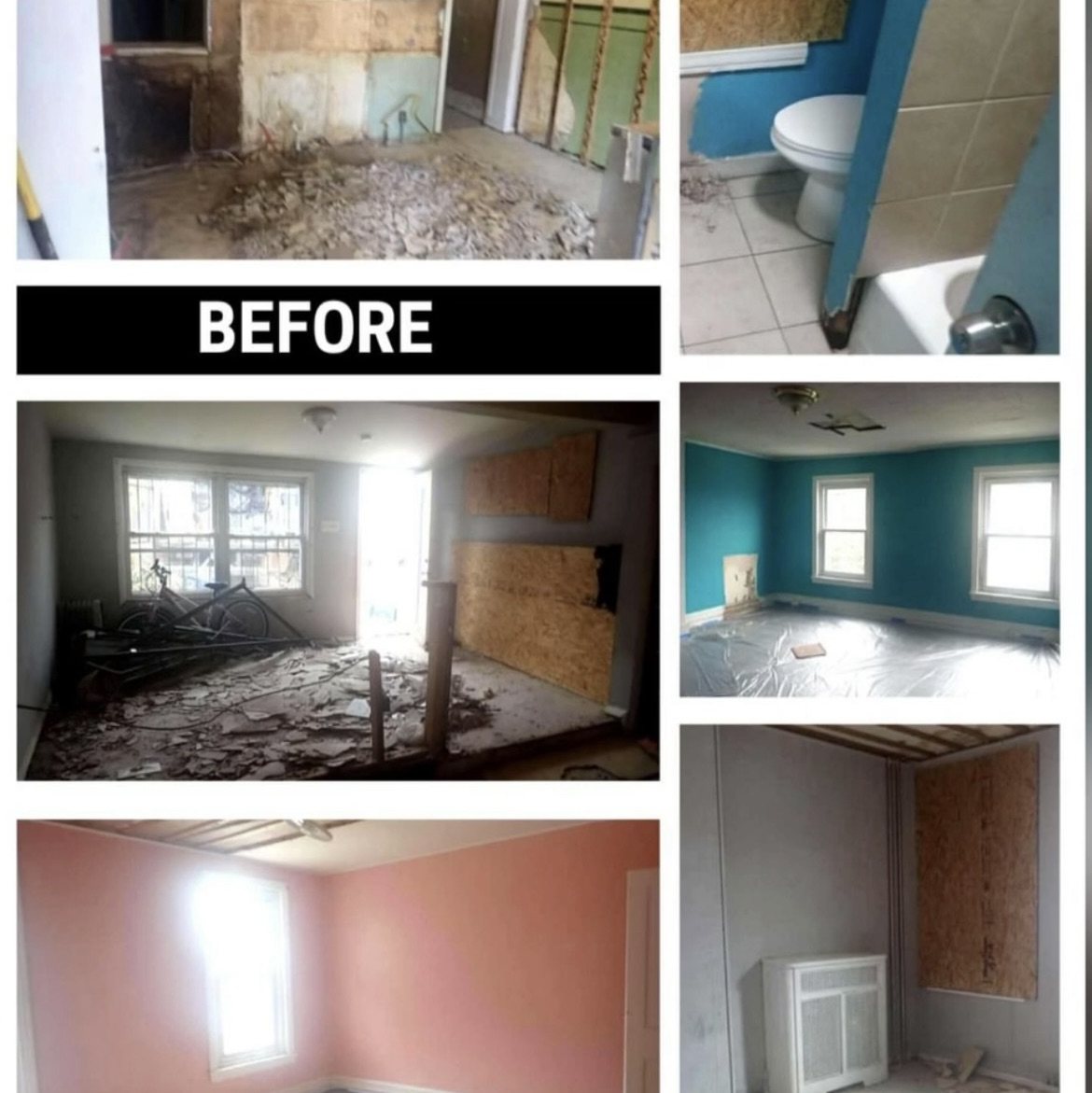
The "Before": Stripped Walls, Distressed Interior, and a Bank’s Worst Nightmare

When this Norristown property landed on our desk, it wasn’t “cosmetic.” It was the kind of interior that makes a retail buyer turn around at the front door.

Here’s what “before” really looked like:

  • Walls stripped down and surfaces torn up—more demo than drywall
  • Distressed interior throughout: rough framing exposure, damaged finishes, and an overall “mid-renovation” feel
  • Outdated or questionable systems (the kind of stuff you only discover once the walls are open)
  • No move-in-ready baseline, which is exactly what traditional lenders want

Before (distressed): A property with stripped walls and significant interior damage in Norristown, PA

Your takeaway: this is where deals are made. The ugly houses usually have the best spreads—if you can fund them and move quickly.

Why Traditional Banks Pass on Deals Like This (Even When the Numbers Work)

Banks aren’t “bad,” but they’re built for stability—not transformation. Here’s why they commonly say no:

  1. Property condition fails basic lending standards: Many banks require livability (functional kitchen/bath, intact walls, working utilities).
  2. Timeline kills the deal: Underwriting, appraisal, and layers of review often can’t match a competitive Norristown/Philadelphia timeline.
  3. They underwrite you more than the deal: Debt-to-income rules and documentation can be a deal-breaker even when ARV (After-Repair Value) is strong.

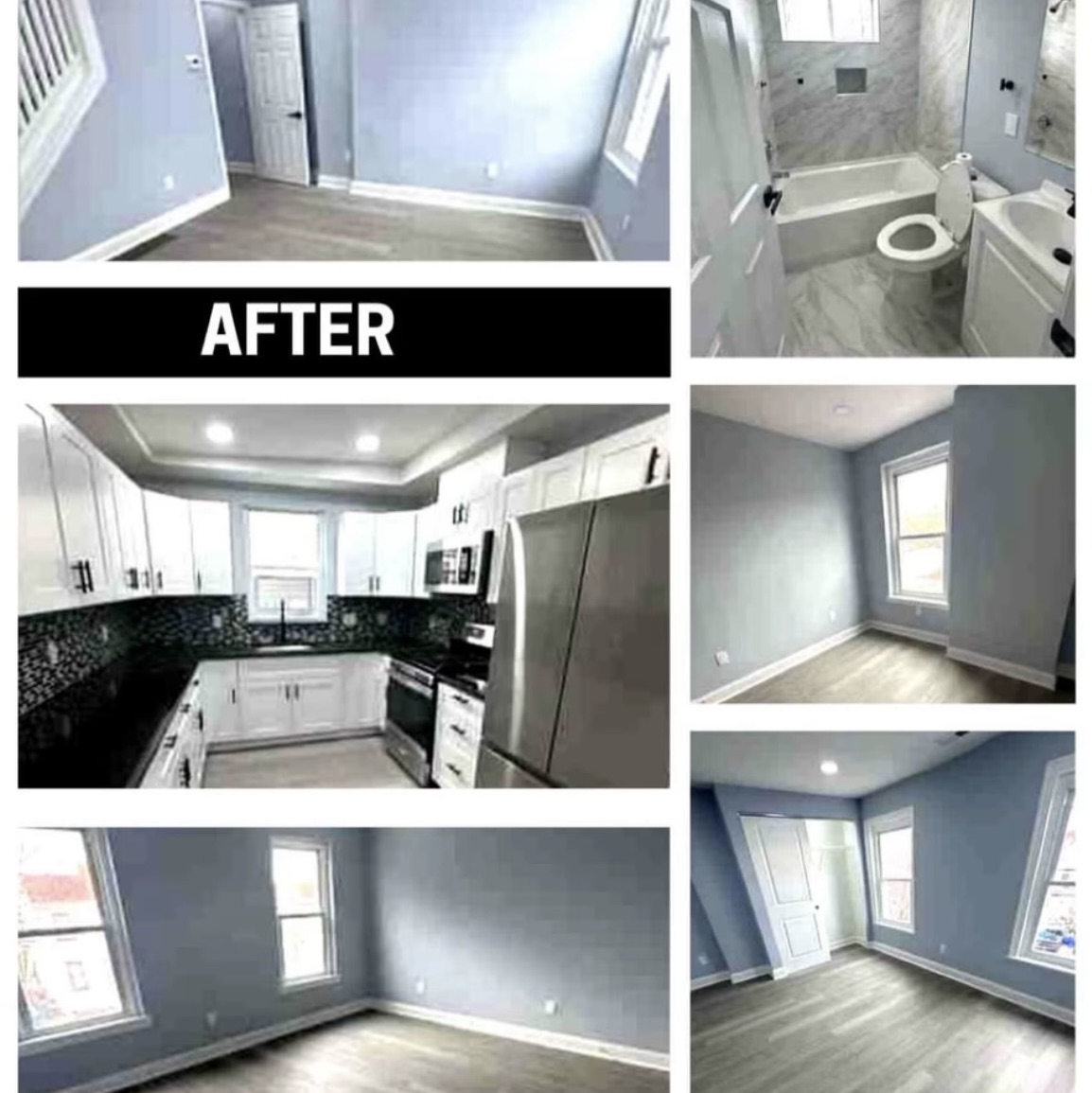
The "After": Modern, Clean, and Truly Move-In Ready

Once the investor had funding lined up, they executed the rehab the right way—by rebuilding the home into what today’s buyers and renters actually want.

In the “after,” you’re looking at:

  • A modern, open, bright layout that feels bigger and cleaner
  • Updated kitchen finishes and contemporary design choices (the stuff that sells)
  • Neutral, move-in ready presentation—no “project vibes,” no weird mismatched updates
  • A home that photographs well, shows well, and can list fast

After (modern): The stunning interior transformation featuring a modern kitchen and open layout

Hard truth: that “after” doesn’t happen if you lose three weeks waiting on a bank. In flipping, speed isn’t a bonus—it’s the strategy.

The Blueprint: The Financing Mechanics That Made It Possible (90% LTC + Fast Close)

Before we dive into the big picture, here’s the simple blueprint behind how we help investors execute projects like this:

  • Up to 90% LTC (Loan-to-Cost): We can fund up to 90% of the total project cost (purchase + rehab). That keeps your cash liquid so you can scale.
  • Rehab funds via draws: Funds are released as work is completed so the project keeps moving.
  • Fast closings: We can often close in as little as 7–10 days, which is a huge edge in the Philadelphia metro market.
  • Designed for investors: This is real real estate investment financing for distressed assets—not retail mortgages.

Once you’ve got leverage working for you, you stop thinking “one flip at a time” and start thinking “pipeline.” If you want to go deeper, the math expert lenders use is what separates funded deals from “almost” deals.

Quick example of the mindset shift:

  • When your lender funds more of the total cost, you can keep cash available for materials, labor spikes, and the next contract—not just this one closing.

By leveraging fix-flip loan basics, you can stay focused on execution while your financing stays predictable. That is how you truly scale.

Avoiding Pitfalls in the Norristown Market

While the rewards are high, flipping houses isn't without its risks. We've seen it all, and we want our clients to succeed. Before you jump into your next Norristown PA investment, make sure you've done your homework.

One of the most common fix-flip mistakes is underestimating the renovation budget. In older Norristown homes, you never know what’s behind the walls until you open them up. We always recommend a 10-15% contingency fund in your budget.

Beyond Pennsylvania: Scaling Nationally

While we love our roots in the Philadelphia area, Emerald Capital Funding is a nationwide private money lender. We are currently seeing massive growth and are actively funding deals in:

  • Tennessee: A hotbed for rental growth and BRRRR strategies.
  • Missouri: Incredible opportunities for low-entry-point flips.
  • Alabama: High-yield potential for long-term holds.
  • Oklahoma: A steady market for consistent investor returns.

Whether you are looking for real estate investment loans in Norristown or a bridge loan in Nashville, we’ve got you covered.

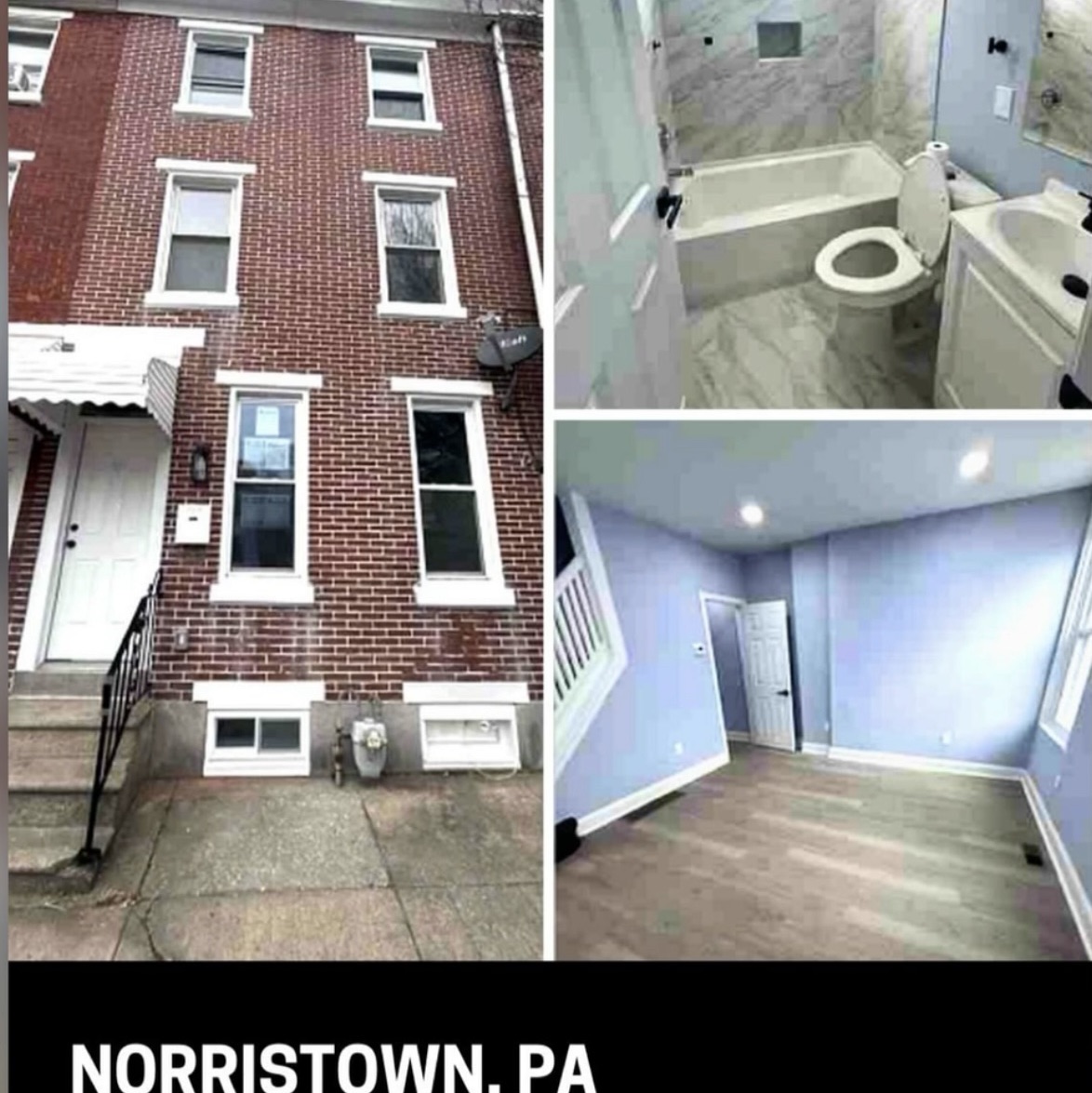
Summary/Exterior: The finished Norristown property ready for the market

Frequently Asked Questions (Q&A)

Q: Do I need a high credit score to get a fix-and-flip loan?
A: While we do look at credit, it is not the only factor. We are primarily concerned with the value of the property and your experience (or the experience of your contractor).

Q: How do renovation draws work?
A: You complete a portion of the work, we send an inspector to verify it, and then we release the funds for that portion. This keeps the project moving and ensures everyone is protected.

Q: Can I transition a flip into a long-term rental?
A: Absolutely! Many of our clients use the "BRRRR" method. They flip the property with a hard money loan and then refinance into one of our DSCR loans once a tenant is in place. You can read more about the 90-day BRRRR timeline here.

Q: What is the difference between hard money and a bridge loan?
A: Great question! Hard money is typically used for heavy renovations, while bridge loans are often used for shorter-term needs on properties that might need less work. We have a cheat sheet here to help you decide.

Actionable Takeaways for Your Next Deal

  1. Know Your Comps: Don't guess the ARV. Look at what has sold in the last 6 months within a half-mile radius.
  2. Get Pre-Approved: Having a proof-of-funds letter from a reputable lender like Emerald Capital Funding makes your offer much stronger.
  3. Build Your Team: Have your contractor and your lender ready to go before you find the deal.
  4. Leverage Your Capital: Don't tie up all your cash in one house. Use nationwide private money loans to scale your portfolio.

Success is Within Your Reach

Transformations like this Norristown project are happening every day. With the right vision and a lender that understands the "why" behind the "what," you can achieve your financial goals through real estate. We are here to provide the pathway to financial security by being your flexible, fast, and professional funding partner.

Don't let a "distressed" property scare you off. With Emerald Capital Funding, we see the modern home hidden under the stripped walls. We’ve got you covered from the first draw to the final sale.


Ready to fund your next project?

Whether you're looking for fix and flip financing or curious about how a DSCR loan can help you hold your properties for the long term, we want to hear from you.

Visit emcap-funding.com to get started.

DM Bill on Facebook to discuss your next deal directly! Let's get your next Norristown transformation off the ground.

Emerald Capital Funding | +1 610-735-7190

Hard Money vs. Bridge vs. DSCR: The ‘Which One Do I Need?’ Cheat Sheet

If you're standing in a seller's living room trying to figure out which loan product to use, or worse, already closed with the wrong one, this guide is for you.

Here's the problem: Hard money, bridge loans, and DSCR loans all sound the same until you're stuck with 14% interest on a stabilized rental that should've been a DSCR loan from day one. Or you picked a DSCR loan for a property that needs $80K in rehab and now you can't close because it won't qualify.

Let's fix that. This is your cheat sheet for knowing exactly which loan fits your deal, before you waste time, money, or momentum.

The Hard Truth: Why Picking the Wrong Loan Kills Your Cash Flow

Here's what nobody tells you: The wrong loan doesn't just cost you a few extra points, it can wipe out your margin entirely.

Take a fix-and-flip in Philadelphia. You grab a DSCR loan because "the rate is lower," but the property needs $50K in work and won't generate rent for 6 months. DSCR lenders don't fund distressed properties. Deal dies. You lose the earnest money.

Or flip it: You use hard money on a turnkey duplex in Nashville that's already rented. Now you're paying 12% interest on a property that could've been a 7.5% DSCR loan from the start. Over 12 months, that's an extra $9,000+ in interest. Gone.

The loan product isn't just financing, it's your profit structure. Pick wrong, and you're bleeding cash before the deal even starts.

Three money stacks showing different loan costs for real estate investors

When to Use Each Loan Type (The Real Breakdown)

Let's break this down in plain English. No fluff. Just the decision tree you actually need.

Use a DSCR Loan When:

  • The property is already stabilized or rent-ready
  • You need little to no rehab (paint, carpet, cosmetic at most)
  • You're buying and holding long-term (3+ years)
  • Predictable rental income matters more than speed
  • You want lower monthly payments and standard market rates

Example: You're buying a turnkey fourplex in Birmingham, Alabama. It's already leased, tenants are in place, and you're holding it for cashflow. DSCR loan all day.

Use a Bridge Loan When:

  • You need fast acquisition funding (7-14 days to close)
  • The property requires moderate to heavy rehab before it generates income
  • You plan to refinance into a DSCR loan after stabilization
  • The property is vacant, distressed, or can't pass DSCR qualification yet
  • You need construction/rehab draws built into the loan

Example: You found a distressed triplex in St. Louis, Missouri. It needs $60K in work, but once renovated, it'll rent for $3,500/month. Bridge loan gets you in fast, funds the rehab, and you refi into DSCR once it's stabilized.

Use a Hard Money Loan When:

  • You need the fastest close possible (sometimes same-week)
  • You're competing against cash buyers and speed is everything
  • You're doing a quick flip (6-12 months max hold)
  • The deal doesn't fit DSCR or Bridge criteria
  • You're willing to pay a premium for speed and flexibility

Example: You're at an estate sale in Oklahoma City. The property is priced $40K under market, but there are three other offers and the seller wants to close in 10 days. Hard money gets you the deal.

Three loan pathways leading to different property types: DSCR, bridge, and hard money

The Math: What Each Loan Actually Costs You

Let's compare apples to apples on a $200,000 rental property purchase in Tennessee:

Feature DSCR Loan Bridge Loan Hard Money Loan
Loan-to-Value (LTV) 75-80% 75-80% of ARV 65-75%
Interest Rate 7.5-9.5% 9-12% 11-15%
Term Length 30 years (fixed) 12-24 months 6-18 months
Monthly Payment ~$1,400 (P&I) ~$1,850 (interest-only) ~$2,200 (interest-only)
Closing Speed 30-60 days 7-14 days 3-7 days
Qualification Property income (DSCR ratio) After Repair Value (ARV) Equity/collateral

What this means for your wallet:

  • DSCR: You're in for the long haul, so the payment stays manageable. Over 30 years, your total interest paid is predictable and cashflow-positive.
  • Bridge: You're paying more monthly, but only for 12-18 months while you renovate and stabilize. Then you refi into DSCR and lock in long-term savings.
  • Hard Money: You're paying a premium for speed. This only makes sense if you're flipping fast or refinancing within 6-12 months. Hold too long and you're burning cash.

Example: On a $200K loan at 14% hard money interest vs. 8% DSCR, you're paying an extra $1,000/month. If you hold for 12 months instead of 6, that's $12,000 in extra interest. That's your profit, gone.

The Bridge-to-DSCR Strategy (The Pro Move)

Here's the strategy most successful investors in Philadelphia and nationwide are using right now:

Step 1: Acquire with a bridge loan (fast close, get the property under contract before someone else does)

Step 2: Complete renovations using bridge loan draws (lender funds the rehab as you go)

Step 3: Lease the property at market rates (get tenants in, stabilize income)

Step 4: Refinance into a DSCR loan (long-term, lower rate, lock in cashflow)

Step 5: Pay off the bridge loan and start building wealth with stable, lower-cost financing

This is the playbook. It gives you speed on the front end (so you don't lose deals) and stability on the back end (so your cashflow works long-term).

Financial calculator and notes comparing DSCR, bridge, and hard money loan costs

Real Scenarios: Which Loan Would You Pick?

Scenario 1: The Turnkey Rental

You found a duplex in Knoxville, Tennessee. It's fully renovated, both units are leased, and the seller wants $180K. You're planning to hold it for 5+ years.

Answer: DSCR loan. The property is already stabilized, so there's no reason to pay bridge or hard money rates. Get the DSCR loan, lock in a low rate, and let the cashflow work.

Scenario 2: The Distressed Flip

You're looking at a single-family in Mobile, Alabama. It needs $40K in work, but the ARV is $220K. You plan to flip it in 8-10 months.

Answer: Hard money or bridge loan. Since you're flipping fast, you need speed and rehab funding. Hard money if you need to close this week. Bridge if you have 10-14 days and want slightly better rates.

Scenario 3: The BRRRR Deal

You found a small multifamily in Philadelphia. It's vacant, needs $50K in rehab, but once fixed and rented, it'll cashflow $1,800/month. You're planning to refinance and hold long-term.

Answer: Bridge loan. This is the classic bridge-to-DSCR play. Bridge gets you in fast, funds the rehab, and once it's stabilized, you refi into DSCR and keep it forever.

Q&A: Your Loan Decision Questions Answered

Q: Can I use a DSCR loan if the property needs minor repairs?

A: Yes: if the repairs are cosmetic (paint, flooring, minor updates) and the property is still habitable and rent-ready. If it needs heavy rehab or won't pass appraisal, you'll need a bridge loan first.

Q: What if I want to use hard money but the rates seem too high?

A: Hard money is expensive on purpose: you're paying for speed and flexibility. If the deal doesn't close in 6-12 months or you're not flipping, it's the wrong loan. Use bridge or DSCR instead.

Q: Can I refinance a hard money loan into a DSCR loan?

A: Absolutely. That's a common exit strategy. Just make sure the property will qualify for DSCR (stable income, good DSCR ratio) before you commit to the hard money loan upfront.

Q: Do you lend in my state?

A: We're based in Philadelphia and actively lending in Pennsylvania, Tennessee, Missouri, Alabama, and Oklahoma: with nationwide expansion underway. Check where we lend here.

The Bottom Line: Know Your Loan, Know Your Profit

The difference between hard money, bridge, and DSCR loans isn't just academic: it's the difference between a deal that works and one that bleeds you dry.

Pick the wrong loan, and you'll:

  • Pay thousands more in interest than you needed to
  • Miss out on deals because you can't close fast enough
  • Get stuck with a property that won't refinance

Pick the right loan, and you'll:

  • Close fast when it matters
  • Keep your cashflow strong
  • Build a portfolio that actually scales

At Emerald Capital Funding, we help investors across Philadelphia and nationwide pick the right loan before they waste time on the wrong one. Whether you're flipping in Philly, buying rentals in Nashville, or scaling in Birmingham, we've got the product that fits your deal.

Ready to figure out which loan your next deal needs? Visit emcap-funding.com or DM Bill on Facebook for a free deal review. Let's make sure you pick the right financing: and keep your profit where it belongs.


Emerald Capital Funding
📞 +1 610-735-7190
🌐 emcap-funding.com

DSCR Qualification Truth: Why Your Tax Returns Don’t Matter (But Your Property Does)

If you're a real estate investor who's tired of having lenders pore over your tax returns like they're decoding the Dead Sea Scrolls, I've got good news. There's a loan product that doesn't care about your 1040, your W-2s, or how many creative deductions your CPA helped you write off last year.

Welcome to the world of DSCR loans, where your property's performance does all the talking, and your personal income paperwork gets to stay in the filing cabinet where it belongs.

The Hard Truth: Traditional Lenders Are Stuck in the Past

Here's what drives most investors crazy: You've built a portfolio of cash-flowing rental properties. Your properties make money every single month. But when you walk into a traditional bank asking for financing on your next deal, they want to see two years of tax returns, three months of bank statements, pay stubs, proof of employment, and probably a DNA sample.

And here's the kicker, because you're a smart investor who maximizes deductions, your taxable income looks lower than what you actually bring home. So even though you're making solid money from rentals, the bank sees your tax returns and says "sorry, you don't qualify."

That's broken logic.

With DSCR loans (Debt Service Coverage Ratio loans), we skip all that noise. We don't need your tax returns. We don't need to verify your employment. We don't need your personal income documentation at all. Instead, we look at what actually matters: Can the property pay for itself?

Property deed approved for DSCR loan qualification while tax returns sit aside unused

What Is DSCR? The Simple Explanation

DSCR stands for Debt Service Coverage Ratio. It's a simple formula that tells us whether a rental property generates enough income to cover its own mortgage payment, plus taxes, insurance, and other costs.

Think of it this way: If you're buying a rental property, the property should be able to pay its own bills. DSCR is just the math that proves it can.

The formula looks like this:

DSCR = Monthly Rental Income ÷ PITI

Where PITI stands for:

  • Principal (mortgage payment)
  • Interest (mortgage payment)
  • Taxes (property taxes)
  • Insurance (homeowner's insurance)

Most DSCR lenders look for a ratio of 1.15x to 1.25x or higher. That means the property's rent should be at least 15-25% more than its monthly mortgage, taxes, and insurance combined.

The Blueprint: How DSCR Math Actually Works

Let's break this down with real numbers so you can see exactly how this works.

Example Property:

  • Monthly rent: $2,500
  • Mortgage payment (P&I): $1,600
  • Property taxes: $300/month
  • Insurance: $100/month
  • Total PITI: $2,000

Now we calculate DSCR:

$2,500 ÷ $2,000 = 1.25

This property has a DSCR of 1.25x, which means it generates 25% more income than its debt obligations. That's exactly what lenders want to see, and it's plenty comfortable for you as the investor because you have cushion room for vacancies, maintenance, or market fluctuations.

Calculator displaying 1.25 DSCR ratio next to rental property model showing positive cash flow

What DSCR Ratios Mean for Your Deal

  • DSCR below 1.0: Property loses money every month. Not happening.
  • DSCR of 1.0-1.14: Property breaks even or barely covers costs. Most lenders won't touch it.
  • DSCR of 1.15-1.24: Solid range. You'll qualify, though rates might be slightly higher on the lower end.
  • DSCR of 1.25+: Sweet spot. Best rates, smoothest approval, happy lender, happy investor.

Here's the beautiful part: This calculation has nothing to do with your personal income. The property either cash flows or it doesn't. Your tax returns from last year? Irrelevant. Your W-2 from your day job? Don't need it. That side business you run that complicates your Schedule C? Doesn't matter.

Why Your Property Does All the Heavy Lifting

Traditional banks qualify you, the borrower. DSCR loans qualify the property. That's the fundamental difference, and it changes everything.

When you apply for a DSCR loan, here's what we actually look at:

The Property's Performance:

  • What's the current or projected rental income?
  • What are the property taxes?
  • What will insurance cost?
  • What's the loan amount and monthly payment?

Your Basic Financial Snapshot:

  • Credit score (typically 620-680 minimum, depending on the deal)
  • Down payment ability (usually 20-25%)
  • Basic asset verification to show you have reserves

Notice what's missing? Pay stubs. Tax returns. Employment verification. Debt-to-income ratios based on your personal income. None of it.

This is game-changing for several types of investors:

  • Self-employed entrepreneurs who write off everything and show minimal taxable income
  • High-earners with complex tax situations (multiple LLCs, partnerships, 1099 income)
  • Seasoned investors building large portfolios who don't want to keep proving their personal income
  • Anyone who values speed and wants to close deals fast without mountains of paperwork

Rental property with upward growth arrows illustrating investment portfolio performance

A Real-World Investor Story

I worked with an investor in Philadelphia last year, let's call him Marcus, who owned four rental properties. All were cash-flowing nicely, bringing in about $8,000/month combined after expenses. On paper, Marcus was killing it.

But when he tried to get traditional financing for property number five, the bank rejected him. Why? Because Marcus is self-employed, runs two LLCs, and his accountant (rightfully) helped him write off everything legally possible. His taxable income on paper? $47,000.

The bank looked at that number and said his debt-to-income ratio was too high, even though his rental portfolio was printing money every month.

Marcus came to us frustrated and ready to walk away from a great deal. We ran the numbers on the new property using DSCR:

  • Projected rent: $2,200/month
  • PITI: $1,750/month
  • DSCR: 1.26x

Property approved. Deal closed in three weeks. No tax returns requested. No explanation of his LLC structure required. Just clean, simple math that showed the property could carry itself.

That's the power of DSCR financing.

DSCR Loans Across Multiple Markets

At Emerald Capital Funding, our hub is in Philadelphia, where we've helped countless investors build rental portfolios using DSCR loans and other real estate investment financing options. But we're not limited to Pennsylvania.

We're actively lending in expansion markets where cash flow opportunities are strong:

  • Tennessee (Nashville, Memphis, Chattanooga)
  • Missouri (Kansas City, St. Louis)
  • Alabama (Birmingham, Huntsville, Mobile)
  • Oklahoma (Oklahoma City, Tulsa)

These markets offer compelling rental yields, and DSCR loans make it easier to scale your portfolio across state lines without the traditional lending headaches. As nationwide private money loans become more common, investors are finally getting the flexibility they need to move fast on good deals regardless of location.

Modern rental property exterior showing cash-flowing investment real estate opportunity

Frequently Asked Questions About DSCR Loans

Q: Do I need perfect credit for a DSCR loan?

A: No. While traditional loans often require 720+ credit scores, most DSCR lenders (including us) work with scores as low as 620-680, depending on your down payment and the property's numbers. If the property cash flows strongly, we can be more flexible on credit.

Q: How much do I need for a down payment?

A: Typically 20-25% down. Some lenders require 25% for investment properties, but if your credit is strong and the DSCR is high, you might qualify with 20% down.

Q: Can I use projected rent if the property is vacant?

A: Absolutely. We use an appraisal that includes a rent schedule showing comparable rents in the area. As long as the appraiser's projected rent supports the DSCR you need, you're good to go.

Q: How fast can I close with a DSCR loan?

A: Much faster than traditional financing. Without all the income verification paperwork, most DSCR loans close in 2-3 weeks. We've done them faster when needed.

Q: Can I use a DSCR loan for a fix-and-flip?

A: No, DSCR loans are specifically for rental properties that generate income. For fix-and-flip projects, you'd want a hard money or bridge loan instead. (Check out our fix-and-flip loan basics if that's your strategy.)

Q: What if my property has a DSCR below 1.15?

A: You have options. You could increase your down payment to lower the monthly payment, find a property with higher rent, or consider a different loan product. We can run the numbers with you to find what works.

Ready to Stop Jumping Through Tax Return Hoops?

If you're an investor who's tired of traditional lenders treating your rental properties like they're some risky science experiment, it's time to explore DSCR financing. Your properties either cash flow or they don't: and that's all that should matter.

Whether you're in Philadelphia looking to expand your portfolio, or you're eyeing rental opportunities in Tennessee, Missouri, Alabama, or Oklahoma, we can help you run the numbers and see if DSCR financing makes sense for your next deal.

Here's what to do next:

  1. Visit emcap-funding.com to learn more about our DSCR loans and real estate investment financing options
  2. Have a property in mind? DM Bill on Facebook: we can run your property's DSCR numbers in minutes and tell you exactly where you stand
  3. Ready to move forward? Apply now and let's get your next rental property funded without the tax return circus

No income verification loans aren't some sketchy workaround: they're smart lending that focuses on what matters: property performance. Let's put your next deal together the right way.


Emerald Capital Funding
📞 +1 610-735-7190
🌐 emcap-funding.com

Nationwide private money loans for real estate investors who value speed, simplicity, and common sense underwriting.

Hard Money vs. Bridge vs. DSCR: The ‘Which One Do I Need?’ Cheat Sheet

If you're standing in a seller's living room trying to figure out which loan product to use, or worse, already closed with the wrong one, this guide is for you.

Here's the problem: Hard money, bridge loans, and DSCR loans all sound the same until you're stuck with 14% interest on a stabilized rental that should've been a DSCR loan from day one. Or you picked a DSCR loan for a property that needs $80K in rehab and now you can't close because it won't qualify.

Let's fix that. This is your cheat sheet for knowing exactly which loan fits your deal, before you waste time, money, or momentum.

The Hard Truth: Why Picking the Wrong Loan Kills Your Cash Flow

Here's what nobody tells you: The wrong loan doesn't just cost you a few extra points, it can wipe out your margin entirely.

Take a fix-and-flip in Philadelphia. You grab a DSCR loan because "the rate is lower," but the property needs $50K in work and won't generate rent for 6 months. DSCR lenders don't fund distressed properties. Deal dies. You lose the earnest money.

Or flip it: You use hard money on a turnkey duplex in Nashville that's already rented. Now you're paying 12% interest on a property that could've been a 7.5% DSCR loan from the start. Over 12 months, that's an extra $9,000+ in interest. Gone.

The loan product isn't just financing, it's your profit structure. Pick wrong, and you're bleeding cash before the deal even starts.

Three money stacks showing different loan costs for real estate investors

When to Use Each Loan Type (The Real Breakdown)

Let's break this down in plain English. No fluff. Just the decision tree you actually need.

Use a DSCR Loan When:

  • The property is already stabilized or rent-ready
  • You need little to no rehab (paint, carpet, cosmetic at most)
  • You're buying and holding long-term (3+ years)
  • Predictable rental income matters more than speed
  • You want lower monthly payments and standard market rates

Example: You're buying a turnkey fourplex in Birmingham, Alabama. It's already leased, tenants are in place, and you're holding it for cashflow. DSCR loan all day.

Use a Bridge Loan When:

  • You need fast acquisition funding (7-14 days to close)
  • The property requires moderate to heavy rehab before it generates income
  • You plan to refinance into a DSCR loan after stabilization
  • The property is vacant, distressed, or can't pass DSCR qualification yet
  • You need construction/rehab draws built into the loan

Example: You found a distressed triplex in St. Louis, Missouri. It needs $60K in work, but once renovated, it'll rent for $3,500/month. Bridge loan gets you in fast, funds the rehab, and you refi into DSCR once it's stabilized.

Use a Hard Money Loan When:

  • You need the fastest close possible (sometimes same-week)
  • You're competing against cash buyers and speed is everything
  • You're doing a quick flip (6-12 months max hold)
  • The deal doesn't fit DSCR or Bridge criteria
  • You're willing to pay a premium for speed and flexibility

Example: You're at an estate sale in Oklahoma City. The property is priced $40K under market, but there are three other offers and the seller wants to close in 10 days. Hard money gets you the deal.

Three loan pathways leading to different property types: DSCR, bridge, and hard money

The Math: What Each Loan Actually Costs You

Let's compare apples to apples on a $200,000 rental property purchase in Tennessee:

Feature DSCR Loan Bridge Loan Hard Money Loan
Loan-to-Value (LTV) 75-80% 75-80% of ARV 65-75%
Interest Rate 7.5-9.5% 9-12% 11-15%
Term Length 30 years (fixed) 12-24 months 6-18 months
Monthly Payment ~$1,400 (P&I) ~$1,850 (interest-only) ~$2,200 (interest-only)
Closing Speed 30-60 days 7-14 days 3-7 days
Qualification Property income (DSCR ratio) After Repair Value (ARV) Equity/collateral

What this means for your wallet:

  • DSCR: You're in for the long haul, so the payment stays manageable. Over 30 years, your total interest paid is predictable and cashflow-positive.
  • Bridge: You're paying more monthly, but only for 12-18 months while you renovate and stabilize. Then you refi into DSCR and lock in long-term savings.
  • Hard Money: You're paying a premium for speed. This only makes sense if you're flipping fast or refinancing within 6-12 months. Hold too long and you're burning cash.

Example: On a $200K loan at 14% hard money interest vs. 8% DSCR, you're paying an extra $1,000/month. If you hold for 12 months instead of 6, that's $12,000 in extra interest. That's your profit, gone.

The Bridge-to-DSCR Strategy (The Pro Move)

Here's the strategy most successful investors in Philadelphia and nationwide are using right now:

Step 1: Acquire with a bridge loan (fast close, get the property under contract before someone else does)

Step 2: Complete renovations using bridge loan draws (lender funds the rehab as you go)

Step 3: Lease the property at market rates (get tenants in, stabilize income)

Step 4: Refinance into a DSCR loan (long-term, lower rate, lock in cashflow)

Step 5: Pay off the bridge loan and start building wealth with stable, lower-cost financing

This is the playbook. It gives you speed on the front end (so you don't lose deals) and stability on the back end (so your cashflow works long-term).

Financial calculator and notes comparing DSCR, bridge, and hard money loan costs

Real Scenarios: Which Loan Would You Pick?

Scenario 1: The Turnkey Rental

You found a duplex in Knoxville, Tennessee. It's fully renovated, both units are leased, and the seller wants $180K. You're planning to hold it for 5+ years.

Answer: DSCR loan. The property is already stabilized, so there's no reason to pay bridge or hard money rates. Get the DSCR loan, lock in a low rate, and let the cashflow work.

Scenario 2: The Distressed Flip

You're looking at a single-family in Mobile, Alabama. It needs $40K in work, but the ARV is $220K. You plan to flip it in 8-10 months.

Answer: Hard money or bridge loan. Since you're flipping fast, you need speed and rehab funding. Hard money if you need to close this week. Bridge if you have 10-14 days and want slightly better rates.

Scenario 3: The BRRRR Deal

You found a small multifamily in Philadelphia. It's vacant, needs $50K in rehab, but once fixed and rented, it'll cashflow $1,800/month. You're planning to refinance and hold long-term.

Answer: Bridge loan. This is the classic bridge-to-DSCR play. Bridge gets you in fast, funds the rehab, and once it's stabilized, you refi into DSCR and keep it forever.

Q&A: Your Loan Decision Questions Answered

Q: Can I use a DSCR loan if the property needs minor repairs?

A: Yes: if the repairs are cosmetic (paint, flooring, minor updates) and the property is still habitable and rent-ready. If it needs heavy rehab or won't pass appraisal, you'll need a bridge loan first.

Q: What if I want to use hard money but the rates seem too high?

A: Hard money is expensive on purpose: you're paying for speed and flexibility. If the deal doesn't close in 6-12 months or you're not flipping, it's the wrong loan. Use bridge or DSCR instead.

Q: Can I refinance a hard money loan into a DSCR loan?

A: Absolutely. That's a common exit strategy. Just make sure the property will qualify for DSCR (stable income, good DSCR ratio) before you commit to the hard money loan upfront.

Q: Do you lend in my state?

A: We're based in Philadelphia and actively lending in Pennsylvania, Tennessee, Missouri, Alabama, and Oklahoma: with nationwide expansion underway. Check where we lend here.

The Bottom Line: Know Your Loan, Know Your Profit

The difference between hard money, bridge, and DSCR loans isn't just academic: it's the difference between a deal that works and one that bleeds you dry.

Pick the wrong loan, and you'll:

  • Pay thousands more in interest than you needed to
  • Miss out on deals because you can't close fast enough
  • Get stuck with a property that won't refinance

Pick the right loan, and you'll:

  • Close fast when it matters
  • Keep your cashflow strong
  • Build a portfolio that actually scales

At Emerald Capital Funding, we help investors across Philadelphia and nationwide pick the right loan before they waste time on the wrong one. Whether you're flipping in Philly, buying rentals in Nashville, or scaling in Birmingham, we've got the product that fits your deal.

Ready to figure out which loan your next deal needs? Visit emcap-funding.com or DM Bill on Facebook for a free deal review. Let's make sure you pick the right financing: and keep your profit where it belongs.


Emerald Capital Funding
📞 +1 610-735-7190
🌐 emcap-funding.com

The 90-Day BRRRR Timeline: When to Flip Your Hard Money Loan Into a DSCR Refi (Before It’s Too Late)

If you've ever heard someone brag about "recycling capital every 90 days" with the BRRRR method, I need to hit you with some reality: they're either lying, using specialty financing you don't know about yet, or hemorrhaging money on holding costs.

The truth? Most investors get stuck paying 10–12% interest on hard money lenders or bridge loans way longer than they planned, not because the rehab went sideways, but because they didn't understand the refinance timeline before they bought the property.

Let's break down what a realistic BRRRR timeline actually looks like, why the 90-day fantasy doesn't work for most deals, and how DSCR loans and the right lender can help you flip out of expensive bridge financing faster, without losing your shirt.


The Hard Truth: Why Investors Get Trapped in High-Interest Hard Money Loans

Here's the mistake I see all the time, especially with newer investors chasing the BRRRR method financing hype:

You close on a distressed property with a 12-month hard money loan at 11% interest. You budget 60 days for rehab. You assume you can refinance into a DSCR loan by day 90 and pull most of your cash back out.

Except… your lender says you need to "season" the property for 6–12 months before they'll use the new appraised value for a cash-out refi.

Now you're stuck holding a loan that was supposed to cost you $8,000 in interest, but you're actually paying closer to $30,000–$40,000 because you're carrying it for 9+ months.

That's the trap.

And if you're working in competitive markets like Philadelphia real estate lending or expanding into high-growth states like Tennessee, Missouri, Alabama, and Oklahoma, you need to understand this timing issue before you make an offer, not after you've already signed.

Real estate investment planning with calculator, cash, and house model showing hard money loan timing


The Blueprint: A Realistic 90-Day Breakdown (And Why It's Actually 6–9 Months)

Let's walk through the math on a typical fix and flip transitioning into a long-term hold with BRRRR.

Month 1–2: Acquisition + Rehab Start

  • Close with hard money or bridge loan (10–12% interest, 12-month term)
  • Begin renovations
  • Holding cost per month: ~$3,000–$4,000 (interest + utilities + insurance)

Month 2–3: Finish Rehab + Rent-Ready

  • Complete renovations
  • Stage for rent
  • List property and begin tenant screening
  • Holding cost: Still $3,000–$4,000/month

Month 3–4: Tenant Placement

  • Lease signed, tenant moves in
  • Property is now stabilized with rental income
  • Problem: Most lenders require 6–12 months of ownership (not just occupancy) before refinancing

Month 6–9: Refinance Window Opens

  • Apply for DSCR refinance (approval based on property cash flow, not your W-2)
  • Appraisal reflects post-renovation value
  • Close on new loan, pay off hard money lender
  • Pull cash out based on 75–80% LTV

Total timeline: 6–9 months minimum (not 90 days).

Total interest paid on hard money loan (at 11%):
If you borrowed $200K and held it for 8 months = ~$14,600 in interest alone.

That's why timing matters, and why choosing the right lender upfront can save you tens of thousands.


The Investor Story: What Happened in Royersford (And Why Speed Wasn't the Problem)

I just wrapped a deal outside Philadelphia in Royersford, PA. The investor bought a tired duplex for $180K with hard money, put $40K into it, and rented both units at $1,400/each.

Smart play, right?

Here's where it almost went sideways: He assumed he could refi in 90 days.

His original bank said no, 12-month seasoning requirement. So he was staring down 8 more months of paying 11% on a $180K loan.

That's when he reached out. We got him into a DSCR loan at month 6 with a specialty lender who works with nationwide private money loans and understands the BRRRR cycle. He pulled $165K cash-out (75% of the $300K ARV), paid off the bridge loan, and pocketed about $85K to put toward his next deal.

Lesson: If you wait until you're ready to refinance to start looking for a lender, you've already lost. You need to lock in your exit strategy before you buy the property.


Local + National: Why Location Matters for BRRRR Timing

If you're investing in Philadelphia real estate lending or nearby suburbs, you're in a strong market with plenty of lender options. That's an advantage, but you still need to compare seasoning requirements.

If you're scaling into Tennessee, Missouri, Alabama, or Oklahoma, markets where Emerald Capital Funding is actively lending, you're often dealing with tighter timelines, faster appreciation, and higher competition. In those states, having access to bridge loans that transition smoothly into DSCR refinances is the difference between scaling fast and getting stuck.

We work with investors nationwide, and here's what we've seen consistently:

  • DSCR loans in Tennessee: High rental demand, fast tenant placement, but you need a lender who understands out-of-state investor timelines.
  • Missouri hard money lenders: Competitive rates, but watch for prepayment penalties that trap you into longer hold periods.
  • Alabama real estate investment loans: Great cash flow markets, but appraisals can lag, plan for 6–9 months minimum.
  • Oklahoma bridge financing: Fast-moving market with solid appreciation, but make sure your lender allows early payoff without penalties.

BRRRR method timeline visualization showing phases from acquisition to DSCR refinance


How to Actually Speed Up the Timeline (Without Breaking the Bank)

Okay, so we've established that 90 days is mostly a myth. But that doesn't mean you're stuck waiting a full year. Here's how to tighten the timeline:

1. Choose Your Refinance Lender BEFORE You Buy

This is non-negotiable. If you're using hard money to acquire, ask your DSCR lender upfront:

  • What's your seasoning requirement?
  • Do you allow cash-out refi at 6 months?
  • What's your appraisal process?

2. Pay for Speed on the Rehab

If waiting an extra 2 months costs you $6,000 in interest, it might be worth paying your contractor a $3,000 bonus to finish early. Do the math.

3. Market the Property at 80% Completion

Don't wait until the property is 100% done to start looking for tenants. List it early, schedule showings, and have a lease ready to sign the day you get the CO.

4. Work With Lenders Who Understand BRRRR

Some DSCR loan lenders are investor-friendly and will work with you at 6 months (or even sooner with strong financials). Others are rigid. Choose wisely.

At Emerald Capital Funding, we structure loans with BRRRR timelines in mind, whether you're in Philadelphia or expanding into Tennessee, Missouri, Alabama, or Oklahoma.


Q: Can I Really Refinance in 90 Days?

A: With most conventional lenders? No. But specialty DSCR lenders and portfolio lenders sometimes offer 3–6 month seasoning if the deal is strong, the property is stabilized, and you're working with an experienced lender who knows how to structure it.

Q: What If I'm Stuck in a Hard Money Loan Past 12 Months?

A: Some hard money loans have extension options, but they're expensive (think 2–3 points + higher monthly interest). It's almost always better to refi out before your term ends. If you're approaching month 10 and don't have a refi lined up, call us, we can help.

Q: Do I Need Perfect Credit for a DSCR Refinance?

A: No. DSCR loans focus on the property's debt service coverage ratio (rental income ÷ debt payment), not your personal income or W-2. Most lenders want 620+ credit, but the property's performance is the main factor.

Renovated rental property exterior after successful BRRRR fix and flip investment


Ready to Exit Your Hard Money Loan the Smart Way?

If you're sitting on a property financed with hard money or bridge loans and you're wondering when (and how) to refinance into a long-term DSCR loan, don't wait until you're scrambling at month 11.

Emerald Capital Funding helps real estate investors nationwide with BRRRR-friendly financing, cash-out refinances, and portfolio growth strategies. Whether you're rehabbing in Philadelphia or scaling into Tennessee, Missouri, Alabama, or Oklahoma, we've got options that actually fit your timeline.

Let's talk:
👉 Apply now: https://emcap-funding.com/apply-now
👉 Learn about DSCR loans: https://emcap-funding.com/dscr-loans-explained
👉 Or DM Bill on Facebook and tell him where you're at in the cycle: he'll walk you through your best move.


Emerald Capital Funding
+1 610-735-7190
Financing smarter exits, faster scaling( nationwide.)

Multifamily DSCR Loans (5+ Units): What Changes When You Cross the Commercial Line?

If you're scaling your real estate portfolio from single-family rentals or small multifamily properties into larger apartment buildings, you're about to cross an important threshold. That magical fifth unit? It doesn't just mean more rental income, it fundamentally changes how lenders look at your deal.

Welcome to the world of commercial multifamily DSCR loans. The good news? You still don't need to show tax returns or W-2s. The structure just gets a bit more sophisticated. Let's break down exactly what changes when you make the leap from 1-4 units to 5+ units, and why understanding these differences can save you thousands (and speed up your next acquisition).

The Great Divide: Why 5 Units Changes Everything

Here's the deal: in the lending world, there's a clear line drawn at five units. Properties with 1-4 units fall under "residential" financing guidelines, backed by entities like Fannie Mae and Freddie Mac. But the moment you hit that fifth unit, you've entered commercial territory.

This isn't just semantics, it affects everything from your loan structure to your down payment requirements. Traditional conventional loans simply aren't available once you cross into 5+ unit properties. That's where specialized DSCR programs for multifamily properties come into play.

Comparison of 4-unit residential vs 5-unit commercial multifamily properties

The shift makes sense when you think about it. A 20-unit apartment building operates more like a business than a house with a basement apartment. Lenders want to see that the property itself can sustain the debt, not just that you personally have a good income.

How DSCR Requirements Shift for Larger Properties

With single-family or small multifamily DSCR loans, you might see minimum DSCR ratios as low as 1.0 (meaning the property's rental income exactly covers the mortgage payment). Some aggressive programs even dip below that.

Once you're looking at 5+ units, expect those minimums to tighten up. Most commercial multifamily DSCR programs require a minimum DSCR of 1.15 or higher. Translation? The property needs to generate 15% more income than the debt payment, a built-in cushion for vacancies, maintenance, and market fluctuations.

That said, some specialized programs for 5-8 unit properties still allow a 1.0 DSCR, especially if other aspects of the deal are strong (solid location, experienced borrower, good cash reserves). But you should plan for more conservative underwriting as you scale up.

Quick Math Refresher:

If your annual debt service (mortgage payment × 12) is $60,000, and your net operating income is $69,000, your DSCR is 1.15. That meets most multifamily thresholds. But if your NOI is only $60,000? That's a 1.0 DSCR, which might work for a duplex but could be a deal-killer on an eight-plex.

The Big Changes You Need to Know About

All Units Must Be Leased and Producing Income

Here's where things get strict. Unlike 1-4 unit DSCR loans (which can finance vacant properties), 5+ unit multifamily DSCR programs require all rental units to be leased and actively generating income at the time of closing.

This means you can't buy a distressed 12-unit apartment building with half the units empty and expect to secure DSCR financing right away. You'd need to either negotiate seller financing, use a bridge loan to stabilize the property first, or bring significant cash reserves to the table.

Multifamily DSCR loan planning with financial documents and property model

Owner Occupancy Is Off the Table

Planning to live in one unit while renting out the others? That won't fly with commercial multifamily DSCR loans. These programs are strictly for non-owner-occupied investment properties. If any portion is owner-occupied, you'll need to explore different financing routes.

Appraisals Focus on Income, Not Comps

Forget about comparable sales being the primary valuation method. For 5+ unit properties, appraisers use income-based approaches. They're looking at your property's ability to generate revenue, cap rates, operating expenses, net operating income, and market rent potential.

This actually works in your favor if you're buying a well-managed property with strong financials. The income approach rewards properties that perform, not just properties in trendy neighborhoods.

Experience Requirements Get Real

Here's one area where you can't fake it. While many DSCR programs for 1-4 units accept first-time investors with open arms, 5+ unit multifamily financing typically requires proven experience.

Most lenders want to see one of the following:

  • Previous ownership of at least one 5+ unit property, OR
  • Track record with three or more smaller 1-4 unit investment properties

If you're new to real estate investing and dreaming of going straight to a 16-unit apartment complex, pump the brakes. Build your experience with smaller deals first, or consider bringing on an experienced partner.

Down Payments and LTV Ratios

You're going to need more skin in the game. While some 1-4 unit DSCR programs offer financing up to 80% LTV (20% down), multifamily properties typically require at least 25% down on purchases.

Here's the breakdown:

  • Purchases: Expect 25-30% down payment requirements
  • Rate-and-term refinances: Max out around 75% LTV
  • Cash-out refinances: Capped at 65% LTV for 5-8 unit properties

The flip side? Maximum loan amounts increase significantly, often reaching $2-2.5 million depending on the lender and property performance. You're playing at a bigger scale now.

Fully occupied multifamily apartment building generating rental income

Still No Tax Returns or W-2s Required

Despite all these changes, here's what stays the same: you still don't need to provide personal income documentation. No tax returns. No W-2s. No employment verification.

DSCR loans, even at the commercial multifamily level, qualify you based solely on the property's ability to cover its own debt. This is massive for investors who have excellent real estate income but complicated personal tax situations, or for those who simply want to scale faster without personal income becoming the bottleneck.

Why This All Matters for Your Portfolio Strategy

Understanding these distinctions helps you plan your growth trajectory intelligently. If you're currently managing three duplexes and eyeing a 10-unit building, you now know that the underwriting process will be fundamentally different.

You'll need to:

  • Ensure all units have paying tenants before closing
  • Accept higher down payment requirements
  • Demonstrate your multifamily experience (or partner with someone who has it)
  • Target properties with strong income performance to hit those DSCR minimums

But here's why it's worth it: commercial multifamily properties offer scale that's hard to achieve otherwise. Managing one 12-unit building is often easier than managing 12 separate single-family homes scattered across town. Your cost per door drops. Your operational efficiency increases. Your wealth-building accelerates.

Q&A: Your Multifamily DSCR Questions Answered

Q: Can I use projected rents instead of actual leases for a 5+ unit DSCR loan?

A: Generally, no. Most multifamily DSCR programs require actual signed leases and current rent rolls. Projected rents might factor into the appraisal's market analysis, but you'll need real tenants paying real rent to qualify.

Q: What if I own two 4-plexes but never a 5+ unit property: does that count as experience?

A: Absolutely. Two 4-plexes give you eight total units of experience, which most lenders will view favorably. Three smaller 1-4 unit properties typically satisfy the experience requirement for moving up to 5-8 unit financing.

Q: Are interest rates higher for 5+ unit DSCR loans compared to smaller properties?

A: They can be, but not dramatically. You're typically looking at an additional 0.25-0.75% on your rate compared to equivalent 1-4 unit DSCR programs. The increased rate reflects the higher risk and commercial classification, but the difference isn't usually a deal-breaker.

Q: How long do these loans take to close?

A: Most multifamily DSCR loans close in 30-45 days, similar to residential DSCR programs. The timeline can extend if property appraisals are complex or if you're dealing with environmental reviews on larger properties.

Down payment comparison: residential 20% vs multifamily 25-30% requirements

Making the Leap with the Right Partner

Scaling from residential to commercial multifamily is a significant milestone in your investing journey. The lending landscape shifts, the requirements tighten, and the stakes get higher: but so does the potential for substantial passive income and long-term wealth.

At Emerald Capital Funding, we specialize in helping investors navigate this exact transition. We understand that your duplex portfolio prepared you for this moment, and we structure multifamily DSCR loans that recognize your experience while keeping the process straightforward.

No tax return hassles. No employment verification. Just strong property fundamentals and a lender who knows how to move quickly on the right deals.

Ready to explore how a multifamily DSCR loan can accelerate your next acquisition? Let's talk about your specific property and create a financing structure that works. Reach out to our team today and let's get you moving on that 5+ unit opportunity sitting in your pipeline.

The commercial multifamily world isn't as intimidating as it seems: especially when you've got a lender who speaks your language and moves at investor speed.

Fix and Flip Secrets Revealed: The LTC Math Expert Lenders Use to Fund (or Reject) Your Deal

If you've ever had a fix and flip deal rejected and wondered why, chances are you ran headfirst into the twin gatekeepers of hard money lending: LTC and LTV. These aren't just alphabet soup acronyms lenders throw around to sound smart, they're the actual mathematical formulas that determine whether your deal gets funded or gets ghosted.

Here's the thing: most investors pitch their deals focusing on the wrong numbers. They talk about profit margins and ARV all day long, but they forget that lenders aren't your business partners, they're risk managers with calculators. And those calculators are programmed with specific formulas that either light up green or flash red the moment your deal crosses their desk.

Let's pull back the curtain and show you exactly how lenders at places like Emerald Capital Funding evaluate your fix and flip deals. Once you understand the math, you'll know how to structure your deals for approval before you ever hit "submit."

What Is LTC (And Why It's Your First Hurdle)

Loan-to-Cost (LTC) is the percentage of your total project cost that a lender is willing to finance. Think of it as the lender's way of making sure you have real skin in the game.

Here's the simple formula:

Maximum Loan Amount = LTC % × (Purchase Price + Renovation Budget)

Most fix and flip lenders offer LTC ratios between 70% and 90%, depending on your experience level, the property type, and the lender's risk appetite. New investors typically see 75% LTC, while seasoned flippers with proven track records might score 85-90%.

Calculator showing 75% LTC ratio for fix and flip loan with house model and cash investment

Let's say you find a distressed property for $150,000 and your contractor quotes $50,000 for renovations. Your total project cost is $200,000. If your lender offers 75% LTC, here's the math:

$150,000 (purchase) + $50,000 (rehab) = $200,000 total cost
75% × $200,000 = $150,000 maximum loan

That means you need to bring $50,000 of your own cash to the table. This is non-negotiable. The lender isn't going to suddenly become generous because you found a "great deal", the formula is the formula.

The Plot Twist: Meet the ARV LTV Cap

Here's where it gets interesting (and where many deals die). Lenders don't just calculate LTC and call it a day. They also run a second calculation based on your After-Repair Value (ARV) using a metric called LTV (Loan-to-Value).

The ARV LTV formula looks like this:

Maximum Loan Amount = LTV % × After-Repair Value

Most lenders cap ARV LTV at 70-75% for fix and flip loans. Using our example above, let's say your ARV is $280,000 and the lender uses a 70% ARV LTV cap:

70% × $280,000 = $196,000 maximum loan based on ARV

Now here's the kicker: the lender will always choose the lower of the two numbers.

In this scenario:

  • LTC gives you: $150,000
  • ARV LTV gives you: $196,000

You get $150,000 because it's the lower figure. The LTC was your limiting factor.

Fix and flip loan approval versus rejection comparison showing lender decision process

When the ARV LTV Becomes Your Enemy

Let's flip the scenario. Same property, same purchase price, same renovation budget, but this time your ARV is only $220,000 (maybe you were a bit optimistic, or the market shifted).

LTC calculation: 75% × $200,000 = $150,000
ARV LTV calculation: 70% × $220,000 = $154,000

You'd still get $150,000 because it's the lower number. But notice how close these numbers are getting? If your ARV was just $10,000 lower at $210,000, your ARV LTV would drop to $147,000, meaning you'd only get $147,000 in financing, even though the LTC formula says you should get $150,000.

This is why lenders order their own appraisals and why they're so skeptical of your contractor's ARV estimates. They're not being difficult, they're protecting themselves from overleveraging on a property that might not be worth what you think it is.

Why This Dual-Constraint System Exists

You might be wondering why lenders bother with two separate calculations instead of just picking one. It's simple: they're covering their bases from two different angles.

The LTC ratio ensures you contribute meaningful capital upfront. If you only put in 10% of the project cost and things go sideways, you might just walk away. But if you've got $50,000 of your own money on the line? You're far more likely to see the project through.

The ARV LTV cap protects the lender if your property value estimate is inflated. Real estate markets can shift, renovations can miss the mark, and comparable sales can be misleading. By capping the loan at 70-75% of ARV, the lender ensures they can recoup their investment even if they have to foreclose and sell at a discount.

How to Present Your Deal for Approval

Now that you understand the math, here's how to structure your deal presentation to maximize your approval odds:

1. Be Conservative with Your ARV
Use actual comparable sales from the past 90 days, not aspirational pricing. If anything, round down slightly. Lenders will verify this anyway, and being realistic builds trust.

2. Show Your Renovation Budget in Detail
Don't just throw out a round number. Break it down by line item with contractor bids. This shows you've done your homework and aren't just guessing.

3. Demonstrate Your Cash Reserves
Have proof you can cover your down payment plus at least 3-6 months of holding costs. Lenders want to see you can weather delays without defaulting.

4. Highlight Your Experience
If you've successfully completed previous flips, showcase them. Track record matters. If you're new, partner with an experienced flipper or bring a detailed project plan.

5. Run the Numbers Before You Apply
Don't wait for a lender to reject your deal. Calculate both your LTC and ARV LTV limits beforehand using conservative assumptions. If the numbers don't work, restructure the deal or walk away.

Property appraisal documents and house models for fix and flip deal preparation

Common Mistakes That Trigger Rejection

Overestimating ARV: This is the number one killer. Investors get emotionally attached to their deals and inflate values. Use conservative comps and adjust for market conditions.

Underestimating Renovation Costs: That $50,000 budget can easily become $70,000 once you start opening walls. Pad your estimates by 15-20% for contingencies.

Ignoring the Lower-of-Two Rule: Some investors run the LTC calculation, see they can borrow 75%, and assume they're golden. Then they're shocked when the ARV LTV cap reduces their financing.

Insufficient Cash Reserves: Even if the loan math works, lenders want to see you have breathing room. Running into a project with zero cushion is a red flag.

Poor Property Selection: Some properties just don't fit fix and flip financing parameters. Properties in declining markets, oversaturated areas, or with title issues will get rejected regardless of the math.

Q&A: Your Burning LTC Questions Answered

Q: Can I negotiate a higher LTC ratio?
A: Sometimes, yes, but only if you bring compensating factors like significant experience, strong credit, substantial reserves, or properties in prime markets. Don't expect first-time flippers to get 90% LTC.

Q: What if my renovation budget increases mid-project?
A: Most lenders won't increase your loan after closing. You'll need to cover overruns with your own capital. This is why conservative budgeting matters.

Q: Do all lenders use the same LTC and LTV percentages?
A: No. Each lender sets their own parameters based on risk tolerance. Shop around, but understand that significantly higher ratios usually come with higher interest rates or points.

Q: How quickly can I get funded once I understand these formulas?
A: With the right lender and complete documentation, fix and flip loans can close in 7-14 days. The math itself is instant: it's the due diligence that takes time.

Q: What's the minimum down payment I should expect?
A: Plan for at least 20-25% of total project cost for most fix and flip deals. Experienced investors might get away with 15%, but 25% is the safe assumption for planning purposes.

Investors reviewing renovation budget spreadsheet for fix and flip project planning

The Bottom Line

The math lenders use isn't designed to keep you out: it's designed to keep bad deals out. Once you understand the dual-constraint system of LTC and ARV LTV, you can structure your fix and flip projects to align with what lenders are actually looking for.

Run your numbers conservatively. Build in cushions. Present detailed, realistic projections. And remember: the goal isn't to maximize your leverage: it's to get funded on deals that actually make money.

When you approach your next flip with this knowledge, you'll stop guessing why deals get approved or rejected. You'll know. And that knowledge is the difference between investors who struggle to find financing and investors who get deals funded consistently.

Ready to Get Your Fix and Flip Funded?

At Emerald Capital Funding, we work with investors who understand the numbers and want a straight-shooting lender who won't waste their time. If you've got a deal that pencils out and you're ready to move quickly, let's talk. We close fix and flip loans fast because we know your profits are sitting in that renovation timeline: not stuck in endless underwriting.

Check out our Fix & Flip Loan Basics page to learn more about our programs, or reach out directly to discuss your next project. The calculator is ready. The question is: is your deal?